
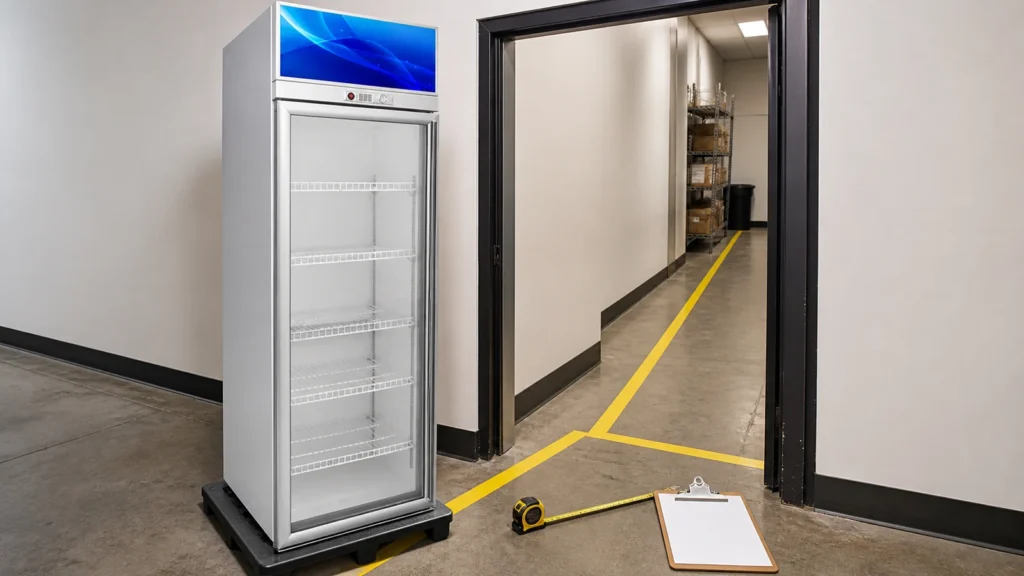
An upright beverage cooler can fit the sales-floor footprint and still fail to reach it. Door closers reduce clear height, a corridor turn needs more space than the cabinet width, and a lift may have enough floor area but insufficient entrance height. Route planning starts with the selected model and adds package and handling information.
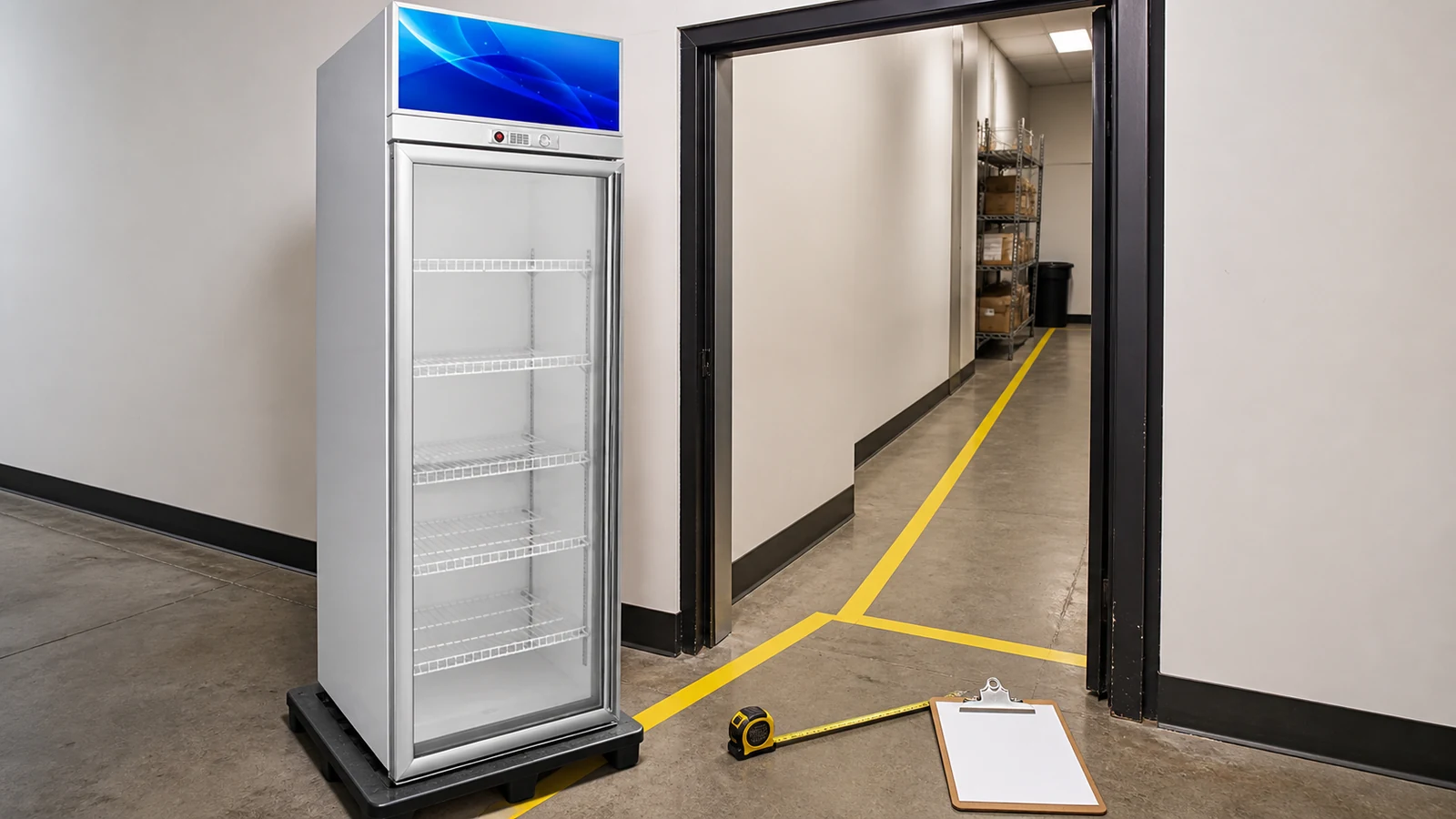
Start With the Listed Cabinet Sizes
ICEAGE lists a single-door 400 L beverage cooler at 600 x 620 x 2050 mm, a double-door 875 L model at 1200 x 620 x 2050 mm, and a three-door 1300 L model at 1800 x 620 x 2050 mm. Confirm dimension order and exact quoted model on the beverage cooler page.
These are listed outer cabinet sizes. Delivery planning also needs package dimensions, pallet or skid, protective frame, protruding components, casters or feet where applicable, and approved handling orientation.
Avoid treating the website dimension as the complete movement envelope.
Request Shipment and Handling Data
Ask for packed length, width, height, gross weight, net weight, center-of-gravity or lifting guidance where provided, permitted orientation, removable packaging sequence, and whether any component removal is allowed.
Record package and cabinet dimensions in separate rows. Confirm which dimensions include the light box, handles, door frame, and base.
The beverage cooler RFQ article helps place route questions beside voltage, plug, door count, and light-box details.
Survey the Entire Route
Walk from truck or loading bay to final position. Divide the route into unloading, exterior approach, entrance, corridor, turns, ramps, lift, sales floor, and final placement.
| Route Point | Measure and Record |
|---|---|
| Loading area | Vehicle access, dock, ground, overhead limits |
| Doorway | Clear width and height with door hardware |
| Turn | Corridor widths, corner radius, obstacles |
| Lift | Entrance, cabin, capacity, leveling, booking rules |
| Ramp or threshold | Rise, slope, edge, floor protection |
| Final zone | Footprint, overhead, door swing, utilities, service access |
Photograph each bottleneck from both directions and mark measurements on a plan.
Measure Clear Openings
Measure the actual clear width and height after doors, frames, closers, handles, panic bars, guards, signage, mats, and thresholds are installed. A construction drawing may show the structural opening rather than usable clearance.
Record whether doors can be safely held or removed, who is authorized, and how they are reinstated. Building and fire requirements still apply.
Check overhead lights, sprinklers, signs, and ceiling changes along the path.
Model Every Turn
A three-door cabinet's long rectangular footprint creates a different turning requirement from a one-door model. Use the packed dimensions and handling equipment envelope to create a scale plan or physical floor mock-up.
Include pallet jack, dolly, forklift, straps, protective boards, operators, and wall protection. The team needs space to control the load, not merely squeeze the cabinet through.
Avoid assuming the cooler can pivot upright on one corner or pass diagonally unless the supplier-approved handling plan supports it.
Check Lift and Vertical Movement
Confirm lift door size, internal cabin size, rated capacity, floor level, call controls, protective lining, booking time, and route from lift to store. Include handling equipment and staff in load calculations under qualified building procedures.
If stairs or hoisting are considered, obtain specialist planning. A general delivery crew may not be equipped for that method.
Record alternative routes and their constraints.
Preserve Upright Handling Requirements
Ask the supplier for the permitted transport and movement orientation. Upright refrigerated equipment may have restrictions related to glass, cabinet structure, and refrigeration system.
Avoid laying or tilting the cooler based on informal advice. If a restricted tilt is approved, record angle, duration, support, and any required waiting or startup procedure from the model documentation.
Keep glass doors secured and protected through the route according to the packing and handling plan.
Plan Floor Protection and Load Control
Review floor finish, joints, thresholds, ramps, load capacity, and surface protection with the builder or store. Hard wheels or concentrated loads can damage completed floors.
Use suitable boards, plates, or protective systems under the approved method. Keep the route clear of customers and unrelated workers.
Weather protection may be needed between vehicle and entrance.
Confirm Final Position
Mark the cabinet footprint, door swing, shopper standing area, restocking position, light-box clearance, ventilation, utility connection, cleaning access, and service access according to the selected model.
The listed beverage coolers use an upright glass-door footprint and are intended for chilled products within the listed 0~10 C range. They are not frozen-storage equipment.
Check that nearby shelves and signs leave doors and service zones unobstructed.
Hold a Pre-Delivery Review
Bring buyer, logistics provider, installer, store manager, builder, and supplier information together. Review model, package, weight, route, equipment, staffing, timing, temporary removals, floor protection, final position, and contingency.
Record open items and responsible owners. Avoid scheduling delivery while one critical doorway or lift measurement remains estimated.
Provide drivers and handlers with the current route plan.
Record Delivery-Day Variations
Photograph package condition before movement and verify dimensions against the plan. If site conditions changed, stop at a safe location and reassess.
Record temporary removals, route deviations, impact marks, and final handoff. Preserve packaging until initial receiving inspection is complete.
Update the route record for future reorders or replacement.
Related Reading
- Beverage Cooler Door Count Guide supports model selection.
- Beverage Cooler RFQ Details collects package and handling questions.
Common Questions
Are listed cabinet dimensions enough for delivery planning?
Package, pallet, protrusions, handling equipment, orientation, and route controls also matter.
Can the cooler be tilted through a door?
Use model-specific supplier handling guidance and a qualified movement plan.
Can glass doors be removed?
Only when the supplier and installer confirm an approved procedure, responsibilities, and reassembly checks.
Which dimension is most often missed?
The missed item varies, but door hardware, overhead limits, turning envelope, and package size all deserve explicit checks.
Send the Route With the Model
Use the ICEAGE contact page to share the selected beverage cooler, route plan, narrowest doors, turns, lift, floor conditions, handling method, final position, voltage and plug market, and required package data. A measured route prevents a cabinet choice from becoming a delivery-day surprise.