
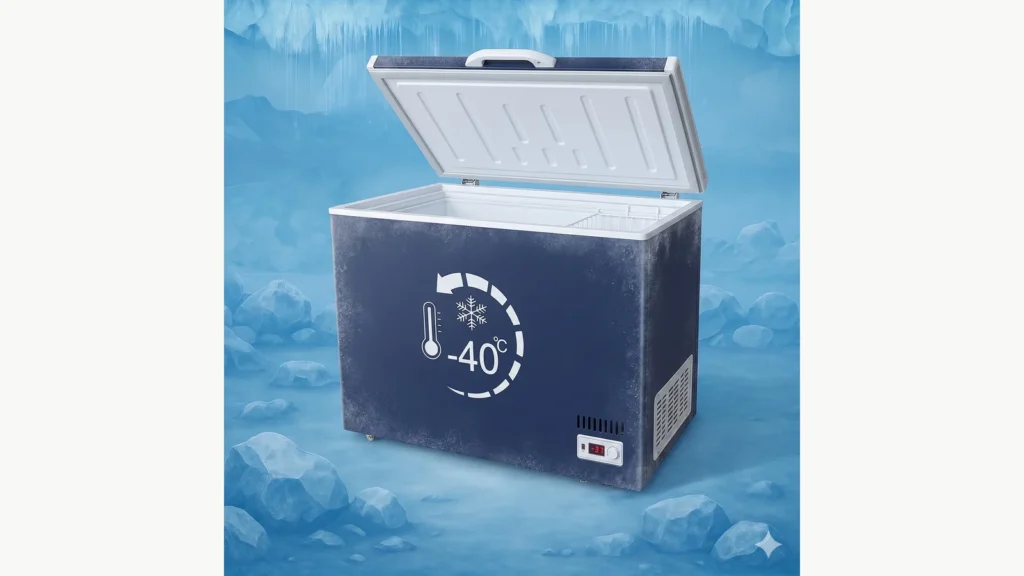
IA-1105 and IA-1110 are close in listed capacity and external size, but they are not equivalent temperature options. IA-1105 is listed at 350 L, 95 W and -24 to 0°C. IA-1110 is listed at 358 L, 170 W and -40 to 0°C. The -40°C capability belongs to IA-1110 only and should not be generalized to the wider chest-freezer range.
The buyer should start with the product's required storage temperature and operating process, then compare the two models. Capacity alone can point to the wrong unit.
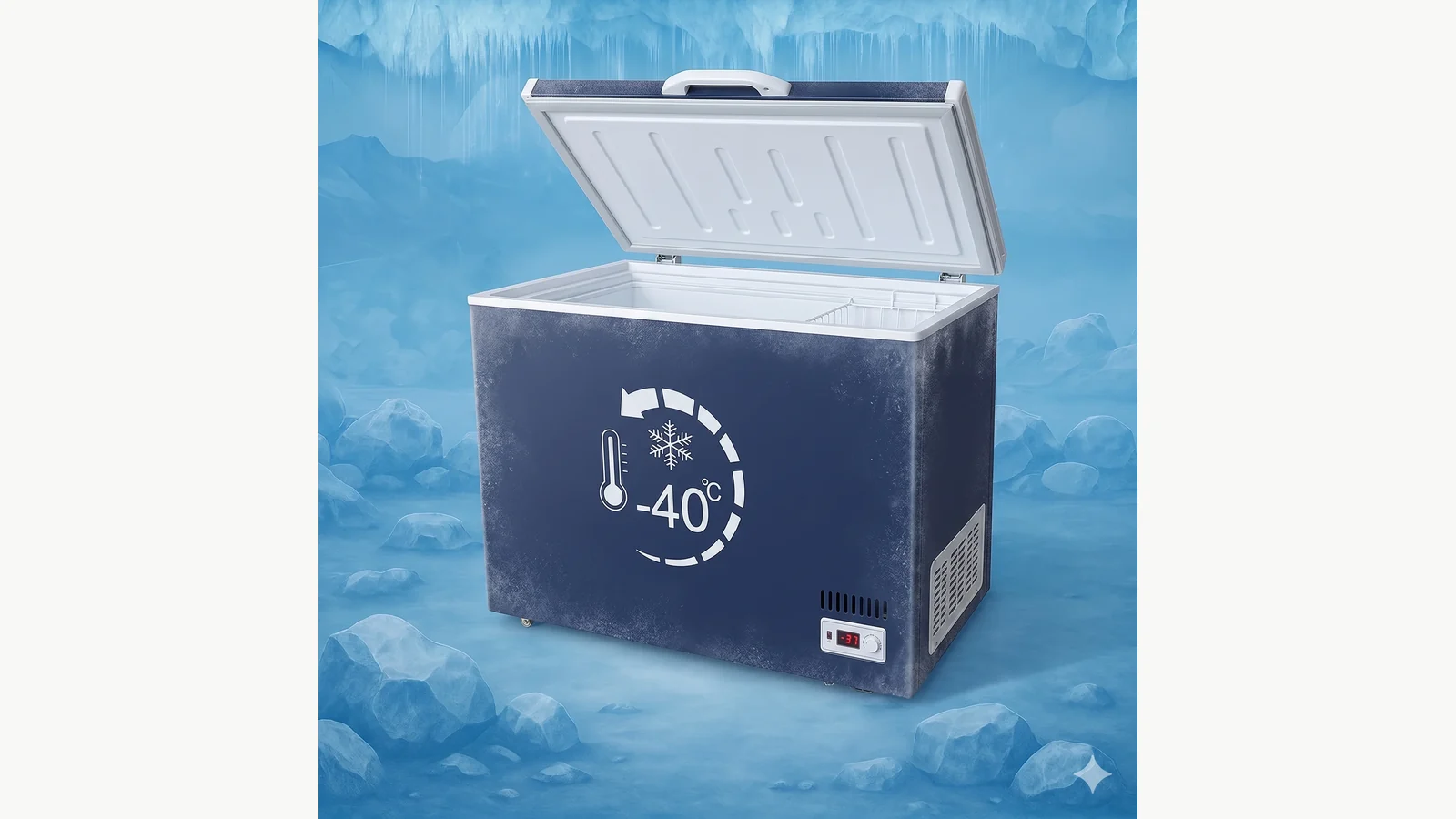
Compare the Published Model Data
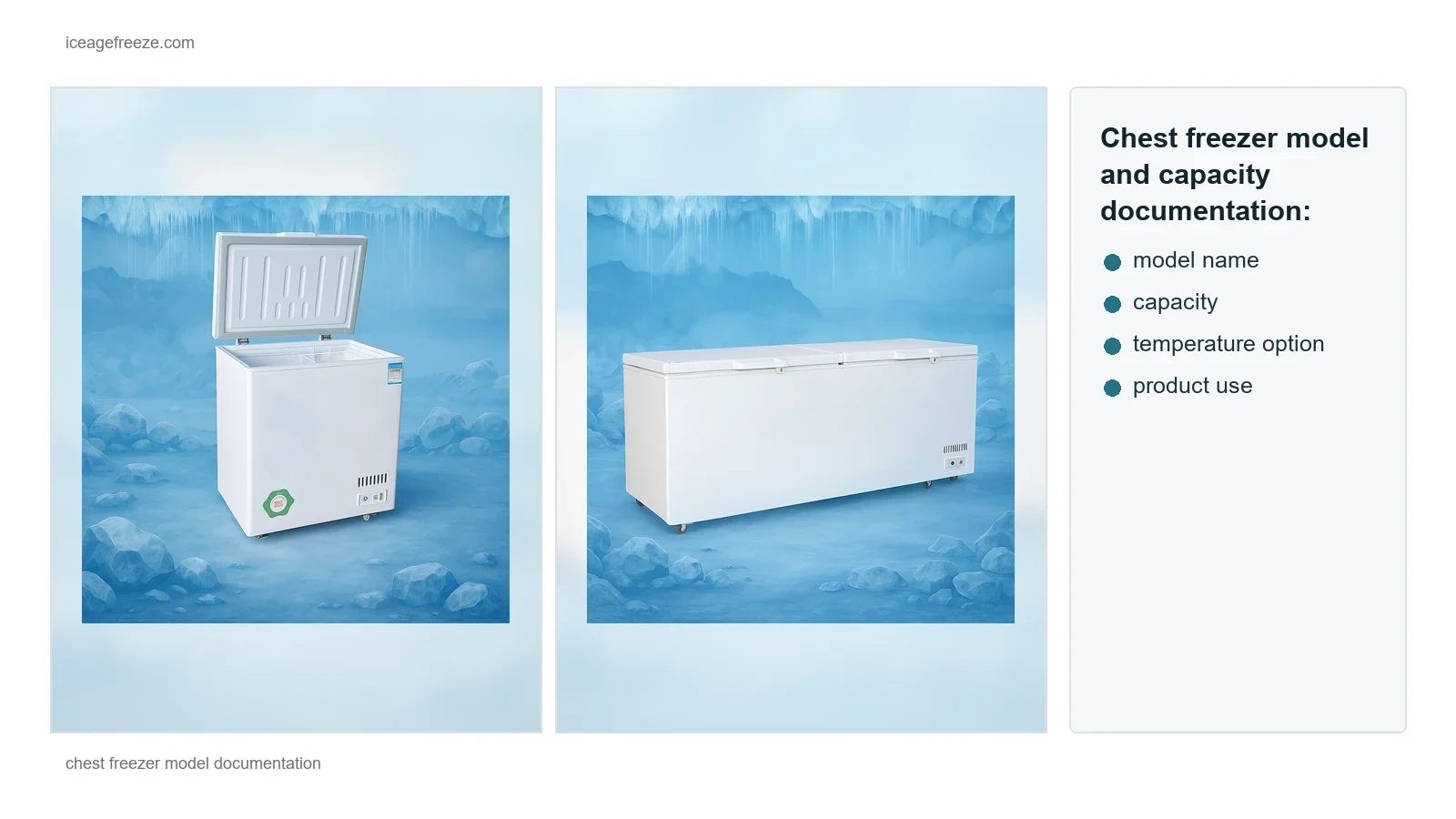
The exact commercial chest freezer product range provides the following model values:
| Model | Listed capacity | Listed input power | Listed temperature range | Listed dimensions |
|---|---|---|---|---|
| IA-1105 | 350 L | 95 W | -24 to 0°C | 1105 × 730 × 900 mm |
| IA-1110 | 358 L | 170 W | -40 to 0°C | 1110 × 730 × 900 mm |
The difference in listed capacity is 8 L and the listed width difference is 5 mm. Those small dimensional differences should not distract from the main selection boundary: IA-1110 has the published -40°C lower limit and a different listed input-power value.
These are catalogue references, not a complete project specification. Confirm the current model datasheet, voltage, frequency, plug or connection, refrigerant, climate conditions, basket configuration, lid arrangement and packing details on the order. The product-family reference includes 220 V / 50 Hz information, but the exact destination supply and batch configuration still require written confirmation.
Choose IA-1105 When the Requirement Fits Its Listed Range
IA-1105 belongs on the shortlist when the buyer's documented product requirement falls within the model's listed -24 to 0°C range and the 350 L format fits the operation. The buyer remains responsible for defining the actual product-storage setpoint and local food or process requirement.
The lower limit is not a promise that every loaded product will immediately reach -24°C. Product temperature depends on the incoming load, package, loading pattern, ambient conditions, door or lid openings, setpoint and operating procedure. Ask for the supplier's performance conditions and commissioning method for the quoted model.
For a normal retail or food-service inquiry, provide:
- product category and required storage temperature;
- incoming product condition;
- normal and peak load quantity;
- package dimensions and basket/divider needs;
- daily opening and refill pattern;
- installation environment;
- site voltage/frequency and plug requirement;
- required temperature-check and alarm procedure.
The purpose is to confirm that IA-1105 fits the actual storage task, not merely the available floor space.
Choose IA-1110 Only for a Verified Deep-Freezing Requirement
IA-1110 carries the published -40 to 0°C range and is described as the deep-freezing option. Select it when the buyer has a real requirement below the IA-1105 range and can define the product, target condition and acceptance method.
The published -40°C commercial chest freezer guide explains the broader evidence needed for deep-freezing applications. The IA-1110 model comparison adds an exact boundary: only IA-1110 in this pair has the -40°C listed lower limit.
Before requesting IA-1110, state:
- the product or material to be stored;
- the required product temperature and permitted range;
- incoming product temperature and load per batch;
- time allowed for the required process, if applicable;
- package type, dimensions and arrangement;
- lid-opening pattern and refill procedure;
- room conditions and required clearances;
- measurement method, sensor placement and acceptance criteria;
- local electrical and regulatory requirements.
The -40°C catalogue value is an equipment range reference. It does not by itself prove a freezing time, product-core temperature, medical suitability, laboratory classification or performance under unreported site conditions.
Capacity Is Not the Main Difference
At 350 L versus 358 L, the two models sit in a similar nominal-capacity class. If the buyer sorts only by litres, both may appear suitable. But usable operations depend on much more than the eight-litre difference:
- required temperature range;
- basket and divider arrangement;
- package geometry;
- loading boundary;
- product access and stock rotation;
- temperature recovery after loading;
- site environment and clearance;
- maintenance and cleaning access.
Ask for the current internal layout and accessory list rather than deriving usable pack count from nominal litres. A package-count estimate needs real package dimensions and an approved loading plan.
Read the Power Values as Model Data, Not an Energy Bill
IA-1105 lists 95 W and IA-1110 lists 170 W. These figures help distinguish the quoted models and inform the electrical review. They cannot directly tell the buyer daily or annual energy consumption.
Energy use varies with ambient conditions, setpoint, loading, openings, cycling and installation. If operating cost matters, request a test method and conditions for any energy data. Keep the site circuit decision with the responsible electrician, using the nameplate and current supplier documents for the delivered unit.
The lower listed wattage is not automatically the better commercial choice. If the product requires the IA-1110 temperature range, selecting IA-1105 to reduce the catalogue power figure would fail the primary storage requirement.
Check Delivery and Placement for Both Models
The published external dimensions are almost identical, but the site still needs a delivery-path survey. Record door clear openings, lift size, corridor turns, floor transitions and final working clearances. Confirm whether the published dimensions include all handles, hinges, bumpers or packaging; use the current packing drawing for logistics.
At the final position, protect ventilation and service clearances shown in the supplier installation manual. Leave room for lid travel and safe stock handling. Avoid a cabinet position where sunlight, heat sources, water exposure or blocked ventilation conflicts with the supplier's installation conditions.
Create a Model-Specific RFQ
Use one line per model; similar capacity alone is not an acceptable substitution basis.
| RFQ field | IA-1105 or IA-1110 evidence |
|---|---|
| Model | Exact model code |
| Required product condition | Buyer-defined temperature requirement |
| Listed temperature range | Confirmed on current datasheet |
| Capacity and dimensions | Confirmed for current production |
| Electrical | Voltage, frequency, input, plug/connection and nameplate |
| Configuration | Lid, baskets, dividers, lock, wheels/feet and controls |
| Environment | Supplier design conditions and clearances |
| Packaging | Export pack, dimensions, gross/net weight and handling marks |
| Acceptance | Start-up, stabilization and temperature-check procedure |
If the supplier proposes an updated configuration, ask which values changed and require a revised document before production release.
Inspect the Delivered Model Before Commissioning
Match the carton, equipment label and documents to the purchase order. Inspect packaging, cabinet, lid, hinges, seals, controls, accessories and power connection. Record visible damage before moving or energizing the unit.
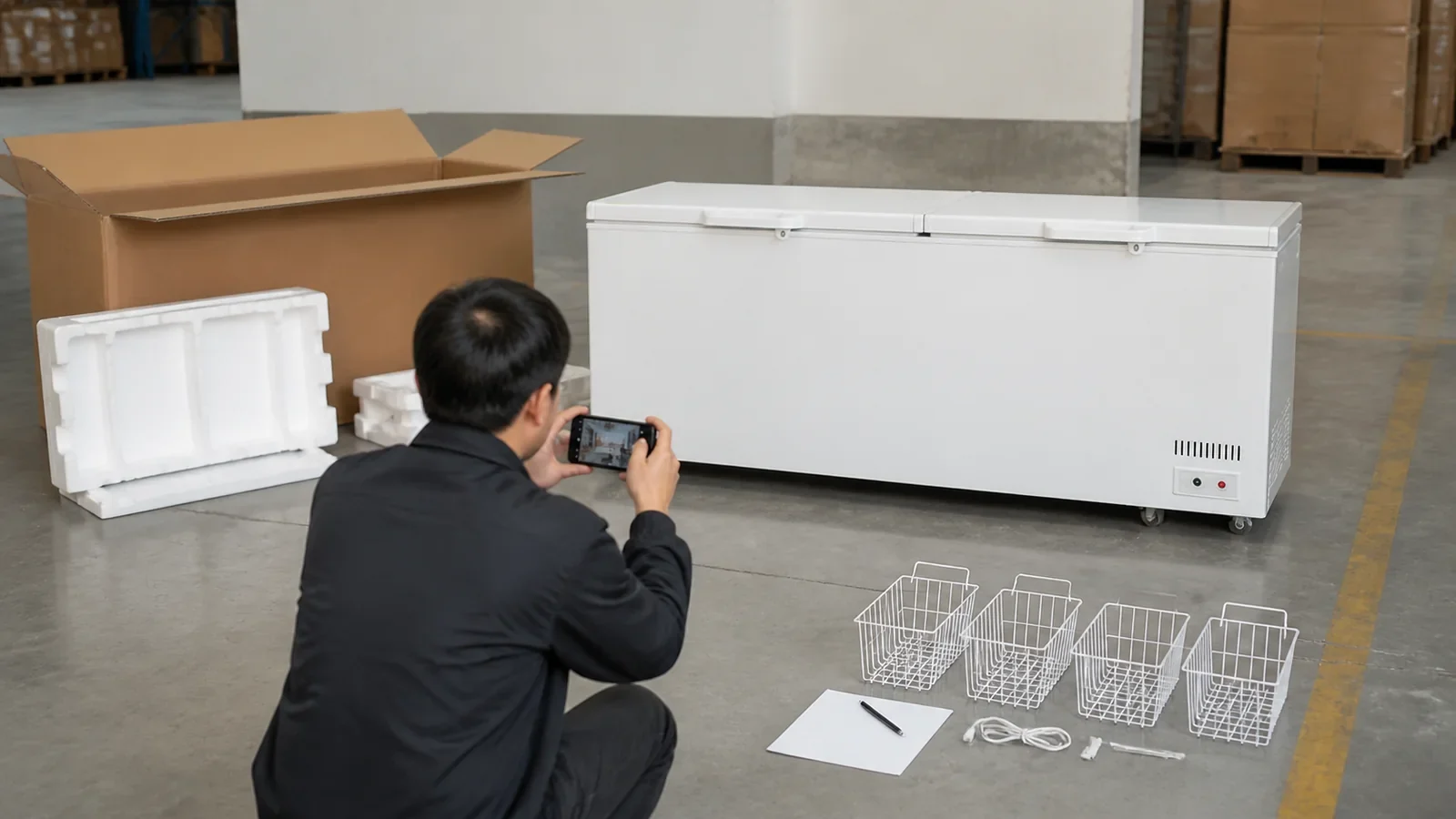
After the unit is positioned, follow the supplier's settling and start-up procedure. The commissioning record should capture model, serial number, nameplate, room condition, setpoint, instrument, measurement locations, start time, stabilization time and results. For IA-1110, the procedure must be appropriate to the buyer's verified deep-freezing requirement; an air-display reading alone is not a complete acceptance method.
If the delivered label, range, electrical data or accessories differ from the approved order, hold the unit for clarification.
Keep the Model Boundary in Reorders
Reorder documents should preserve the exact model code and approved revision. IA-1105 is not a default substitute for IA-1110, and IA-1110 should not replace IA-1105 without reviewing temperature requirement, electrical data, cost and operating process. Attach the earlier approval record and ask the supplier to identify changes before shipment.
Send the Requirement, Not Just the Litres
Send ICEAGE the product type, required temperature, incoming load, package dimensions, operating pattern, site conditions, electrical supply, configuration and acceptance method. Ask for the current IA-1105 or IA-1110 datasheet and quotation to confirm every order-specific value.
The selection is simple only after the requirement is precise: IA-1105 for a requirement inside its published -24 to 0°C range; IA-1110 when a verified process needs the model's published -40 to 0°C range and the buyer can validate it properly.