
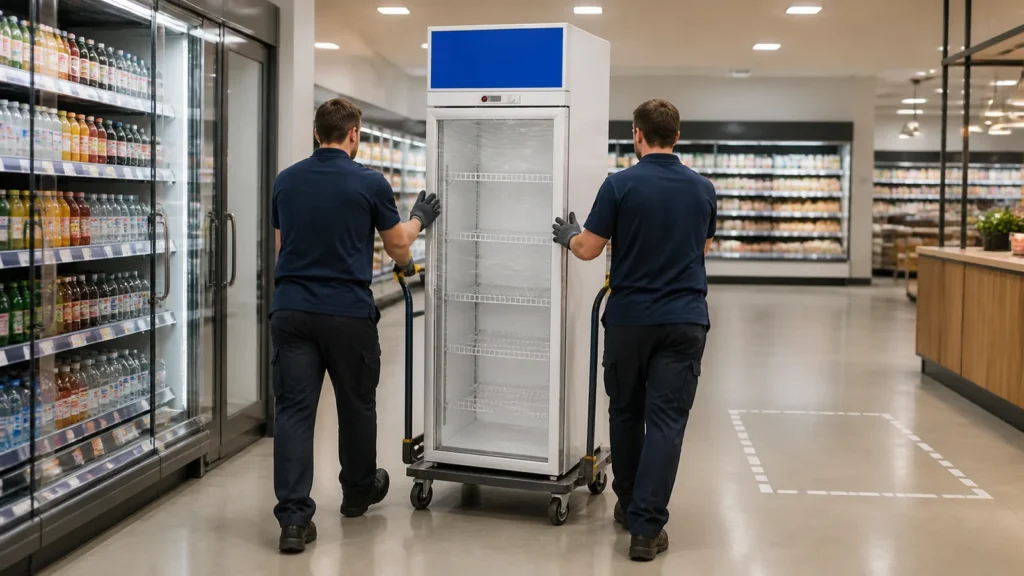
Moving a beverage cooler from one side of a store to another is a new equipment-handling event. The route may be narrower than the original delivery path, shelves and clips can move, the glass door can be exposed to impact, the new floor and surrounding fixtures differ, and utilities must be reassessed. A controlled relocation separates product removal, empty-cabinet preparation, movement, new-position checks, and qualified recommissioning instead of treating the cooler like ordinary shelving.
Define the Old and New Positions
Assign location IDs and photograph the cooler from all sides at the old position. Record model, door count, current outer dimensions from the verified product sheet, cabinet and shelf IDs, visible condition, utilities, adjacent fixtures, floor, wall, and service access.
Draw the new position with aisle, door swing, restocking path, wall and fixture distances, utility route, ventilation and service requirements from the actual model documentation. Never approve a location from cabinet width alone.
Survey the Entire Movement Route
Use the cabinet's verified dimensions and handling guidance to check doorways, turns, ceiling constraints, floor transitions, ramps, lifts, and temporary obstructions. The current range lists outer-size examples of 600 x 620 x 2050 mm, 1200 x 620 x 2050 mm, and 1800 x 620 x 2050 mm, but the actual model must control. The delivery-path guide provides a dimensional method.
Identify who controls doors, customers, stock, and the work area during movement. Protect glass and cabinet surfaces with approved materials without hiding handling points or labels.
Empty and Prepare the Cabinet
Move chilled products through the store's approved product-handling process. Photograph and record the shelf configuration, then remove or secure shelves, clips, keys, and loose parts according to the model guidance. Label every component by cabinet and bay.
Disconnect, isolate, or technically prepare the cooler only through qualified procedures. Never tilt, lift, pull by the door or handle, or choose a standing/restart period from generic advice. The responsible supplier or service professional must define model-specific handling.
Move Through a Controlled Handoff
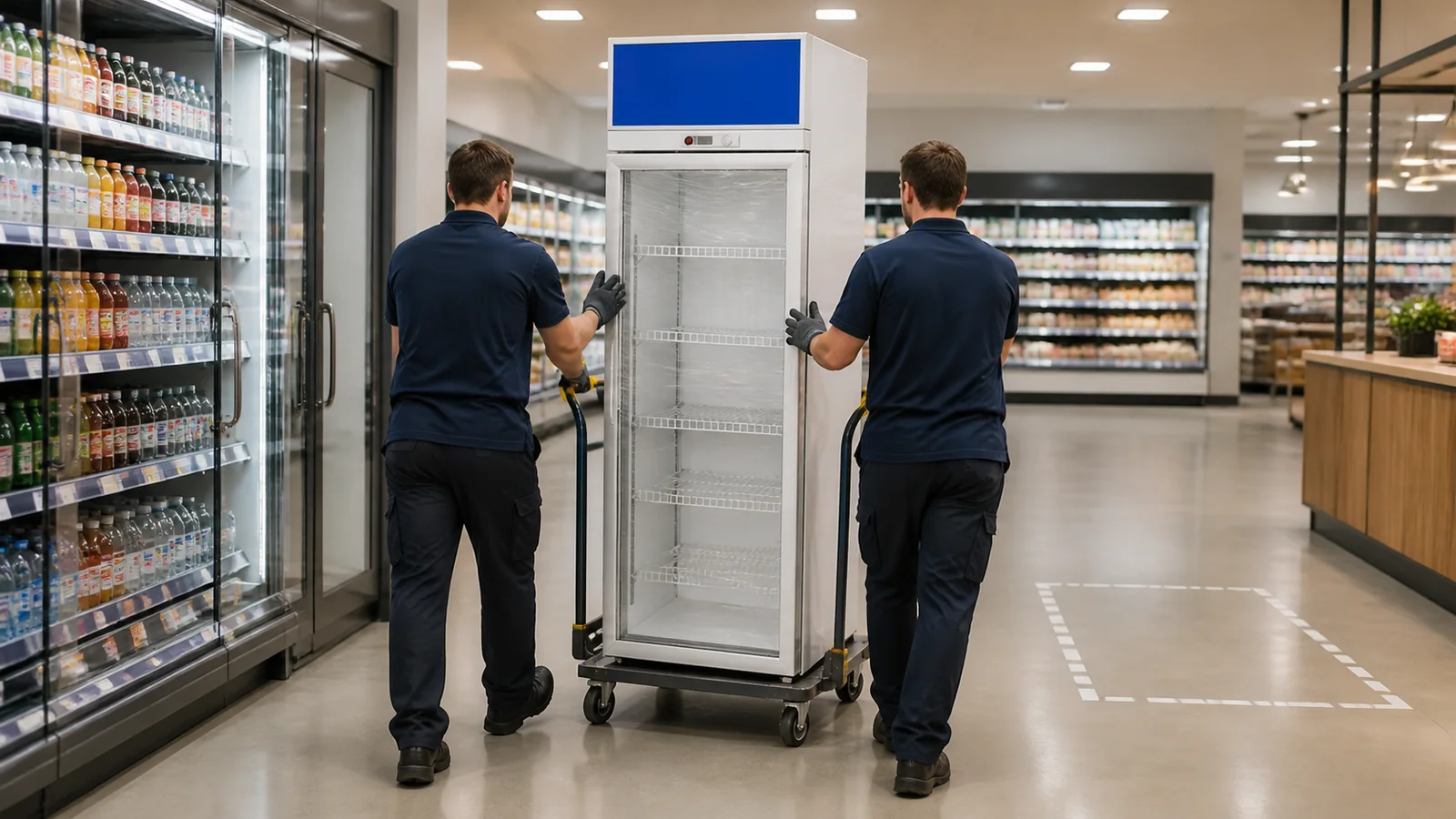
Use appropriate equipment and trained personnel for the cabinet size and route. Assign one movement leader and spotters, protect floors and corners, and keep the glass-door side visible. Pause if the route, equipment, or cabinet behavior differs from the plan.
Record any contact, abrupt tilt, dropped component, package damage, or new visual mark immediately. Never wait until the cabinet reaches the new location, when cause and location may be disputed.
| Relocation Gate | Evidence Before Release | Responsible Handoff |
|---|---|---|
| Old position | Asset, condition, shelf map, utilities | Store to moving team |
| Route ready | Dimensions, turns, protection, access control | Site to moving team |
| Cabinet prepared | Product removed, loose parts controlled | Service/store to moving team |
| New position | Floor, alignment, access, utilities | Moving team to service |
| Restocking | Qualified recommissioning and store acceptance | Service to operations |
Inspect the New Position Before Recommissioning
Compare cabinet panels, base or casters, glass door, frame, handle, seal line, hinges, light box if present, shelves, supports, plug and cable as accessible, and any new mark with the old-position photos. Observe whether doors move and close visibly as intended only under safe and approved conditions.
Confirm the cabinet sits in the approved position with required access and no conflict with nearby doors, shelves, stock, or customer flow. Leveling, connections, technical tests, and recommissioning belong to qualified personnel using the selected model requirements.
Hand Back to Store Operations
Record new location, movement date, responsible teams, route exceptions, final condition, loose-parts reconciliation, shelf map restoration, service findings, recommissioning release, and store acceptance. Restock under the store procedure only after release.
Observe door movement, shelf seating, lighting, glass condition, and any unusual moisture or sound during normal operation, then route technical concerns to qualified service. Use the glass-misting observation log if visible moisture appears after the move without assuming relocation is the cause.
Document Utility and Site Interfaces at the New Position
The new position must be assessed as a small equipment site, not merely an empty rectangle. Record the verified electrical supply and plug arrangement through qualified personnel, cable route, permitted connection point, surrounding fixtures, floor condition, wall and ceiling features, door swing, restocking aisle, customer approach, cleaning access, and model-specific ventilation or service requirements. Never use an extension, adapter, modified plug, or improvised connection unless the responsible qualified and local process permits it.
Compare old and new interfaces in a table. A move can shorten customer access while creating a tighter service side, a cable crossing, direct contact with another fixture, or a door conflict. Assign each difference to store design, electrician, service technician, equipment supplier, or another accountable owner. The relocation should pause when a critical interface lacks approval.
Before technical recommissioning, verify the asset has not been confused with another cooler and that shelves, clips, keys, and loose parts return to the correct cabinet and bay. Record cabinet orientation and any period it was tilted or transported as required by the movement team. Qualified service uses that history and the exact model guidance to determine next steps; store staff should not select a restart time from general internet advice.
The final site handover should include an as-positioned photo, route exceptions, condition comparison, electrical/service release, shelf map, door and glass observations, and any restrictions. Update the store asset plan so later maintenance can find the new location. A relocation is complete only when physical position, technical release, retail access, and records all agree.
Review the New Position After Normal Store Use
A post-move review should occur after staff have restocked and customers have used the aisle. Check whether the door path remains clear, cartons accumulate in the service space, the shelf map is maintained, cable and fixtures stay protected, cleaning access works, and any visible moisture or alignment observation has changed. Record issues against the new location and route them to store design, operations, or qualified service. The review never substitutes for commissioning; it confirms that the accepted position remains workable during real retail tasks.
Preserve Warranty and Service Evidence
Before movement, check the commercial and service record for notification, approved mover, handling, and documentation requirements. Keep asset identity, condition photos, movement method, route events, qualified service report, and final acceptance together. Never promise that relocation preserves or cancels coverage without the applicable supplier terms. A complete evidence set lets the responsible parties evaluate a later concern fairly.
Buyer Checklist
- Identify and photograph the cooler at its old position.
- Approve the new position using the actual model and service requirements.
- Measure every route segment, turn, threshold, and height constraint.
- Remove product and control shelves, clips, keys, and loose parts.
- Use trained personnel and suitable movement equipment.
- Compare old/new condition before qualified recommissioning.
- Record new location, service release, shelf restoration, and store acceptance.
Frequently Asked Questions
Can the cooler be moved while stocked?
Use the store, supplier, and qualified handling procedure; controlled product removal and loose-part management usually provide clearer protection and accountability.
How long should it stand before restart?
Follow the exact model, orientation history, supplier, and qualified service guidance; there is no universal time in this article.
Can the cabinet be pulled by its door handle?
Never use doors or handles as movement points unless the manufacturer's handling guidance explicitly permits it.
Related Product or Reading
For initial route dimensions, use beverage cooler delivery-path checks. Relocation adds old/new condition and qualified recommissioning records.
Discuss the Exact Project
Send IceAgeFreeze the exact model, door count, old and new positions, route dimensions, handling constraints, utilities, shelf configuration, and qualified service questions.