
A glass door beverage cooler sells with its face. The customer sees the door, the lit shelves, and the product, and among the first things that either helps or slows a purchase is the price. A price that is visible and right lets a customer decide in a glance; a price that is missing, wrong, or buried behind a bottle sends the customer looking for staff or walking past. Price rails and shelf signage are the small fixtures that keep that pricing visible and the display neat, and they deserve to be planned rather than stuck on as an afterthought.
This guide is written for a store planning the merchandising setup on a glass door beverage cooler. It covers the price rail styles a store can plan with, where to place signs so the eye finds them, how to match signs to shelf zones, how to keep labels readable through the glass door, and what to confirm with the supplier before the setup is finalised.
Why pricing belongs in the cooler plan
Pricing is a merchandising question before it is a hardware question. A cooler where every product is priced at the same height, in the same place, and in a legible size lets the display do the selling, and it lets staff restock without re-deriving where the labels go. A cooler where prices are inconsistent forces customers to hunt and staff to answer the same "how much is this" question all day.
The plan also protects the display itself. A label taped to a shelf front falls off and leaves residue; a hand-written tag fades and drifts; a sign that blocks the product defeats the purpose of a glass door. The price rail and signage plan exists so the pricing stays useful without damaging the cooler or hiding the stock.
Price rail styles a store can plan with
The fixtures themselves come in a few common store-supplied styles, and a store picks the one that fits the shelf front it is working with. A clip-on shelf-edge strip slides onto the front of a shelf and holds a paper or card label. An adhesive label holder sticks to a flat surface and suits a shelf or door frame with no lip to clip. A hanging tag hangs from a shelf or product and works where the shelf front is already full. A shelf talker is a slightly larger sign that sits under a product and carries a price plus a short note.
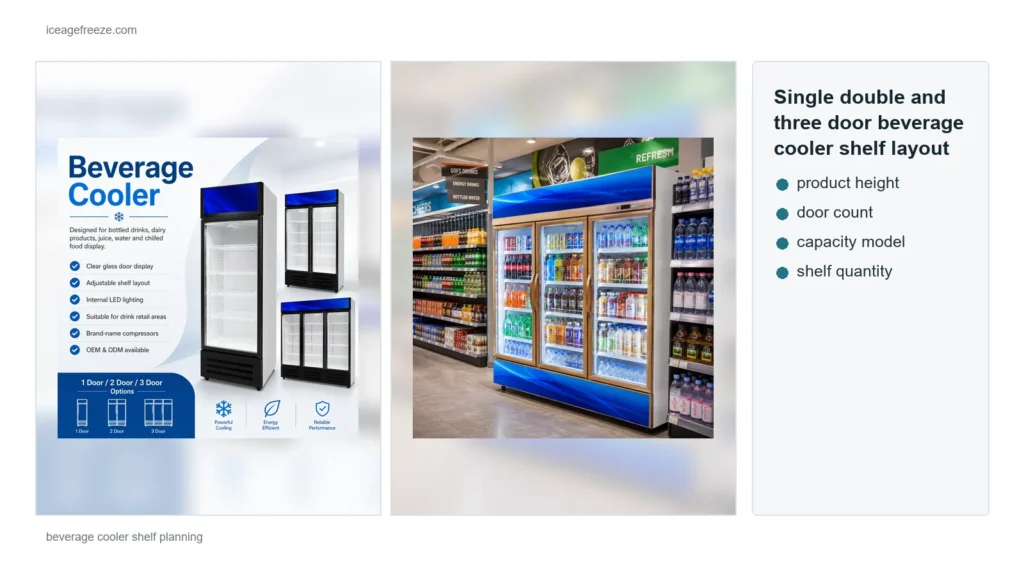
Which style works is partly the store's choice and partly the cooler's build. A glass door beverage cooler has adjustable shelves, so the shelf front a rail clips onto depends on how the store has set the shelf height and which model it is running. The beverage cooler range spans a single door 400 L, a double door 875 L, and a three door 1300 L cabinet, each with its own shelf layout, so the store confirms the shelf edge and its depth on the unit in front of it. Whether a particular rail is included or needs to be supplied separately is a supplier question, and it is settled before the store buys a stack of fixtures that clip onto nothing.
Place signs where the customer's eye already goes
The best position for a price is the position the customer is already reading. On a glass door cooler, that is the front edge of the shelf, at or just below eye level, in one consistent spot across the whole cabinet. A customer who learns that the price sits at the front-left of every shelf stops searching and starts scanning. Consistency across the door matters as much as the position on any one shelf, because the eye follows a pattern it recognises.
Lighting works with the sign, and a glass door cooler's interior LED lighting is what makes a small label readable from across an aisle. A label that is in shadow or turned away from the light wastes the lighting the cabinet already provides. The store checks that the sign faces the door, not the back of the cabinet, and that it sits where the light reaches it.
Match the sign to the shelf zone it describes
A price sign only makes sense when it sits with the product it prices. The store groups the cooler into zones — bottled drinks, dairy, juice, water, chilled snacks — and each zone carries its own prices. The sign for a dairy product sits in the dairy zone, not two shelves away, and when a product moves to a new shelf during restocking, its label moves with it. A label left behind after a product moves is how a cooler ends up with prices that contradict the product sitting above them.
The zone side of the plan is covered in the beverage cooler shelf planning guide, which works through which products belong on which shelves. This piece sits on top of that: once the zones are set, the signage describes them at the shelf front.
Keep labels readable through the glass door
The glass door is the reason the cooler looks good, and it is also the surface the customer reads through. A label that is too small, too low, or angled away from the door disappears behind the glass and the product. The store checks each sign from the customer's side of the door, not from the staff side, because the two views are different. A sign that reads clearly from behind the cabinet can be cut off by a shelf edge or a bottle when viewed from the front.
The check is visual and quick: stand where a customer stands, read every price, and fix the ones that are tilted, blocked, or shadowed. A label that a customer cannot read in a glance is a label that is not doing its job, however carefully it was printed.
Door cleanliness belongs in the same check, because a glass door that carries smudges or condensation obscures every label behind it at once. A store that wipes the glass as part of the pricing check keeps both the product and its price readable, and it catches a label problem the moment it becomes visible rather than the moment a customer asks.
Confirm the fixtures and branding with the supplier
The supplier confirmation closes the plan. The store confirms what the cooler already includes — the shelf quantity, the door layout, and any light box or logo branding on the cabinet — and what the store needs to supply itself, such as the rails and label holders. The beverage cooler page lists the OEM options, including logo sticker, light box design, and shelf quantity adjustment, so the shelving and branding questions are part of the same conversation as the price rails.
The confirmation also settles the model-specific details. The single, double, and three door models differ in shelf count and cabinet width, so a rail plan written for one door count does not automatically carry to another. The store confirms the shelf edge and door layout against the specific model before committing to a fixture order, in the same way it would confirm any other detail against the unit it is actually buying.
Keep signage current when prices and products move
A price plan is only as good as its upkeep, and the two events that age a sign are a price change and a product move. When a price changes, the store replaces the label in place rather than crossing it out or sticking a second tag over the first, because a patched label reads as careless and invites a price dispute at the till. When a product moves to a new shelf during restocking, its label moves with it, and the old position is cleared rather than left to mislabel whatever sits there next.
The upkeep is easier when the store keeps one master list of what sits in each zone and what it costs. The list is the reference the staff check a label against, and it is what the store updates when a price or a product changes. A store that updates the list and the shelf at the same time keeps the display honest, while a store that updates only one of the two ends up with shelves and signs telling different stories. Promotional signs follow the same rule: a sale label is dated and removed when the offer ends, because an expired offer left in the door is a complaint waiting at the counter.
None of this is heavy. It is a few minutes a day against the cost of a customer who reaches the till holding a wrong price in hand, and it is the difference between a sign plan that holds up and one that quietly falls apart after the first price change.
Related reading
A signage plan sits inside the wider merchandising and restocking routine. The glass door beverage cooler restocking guide covers the shelf maps and handoffs that keep the display correct after it is set, and the interior LED lighting article covers the visibility that makes the signs readable. The full product index shows the equipment a store plans across, and for model-specific questions, the team can be reached through the contact page.