
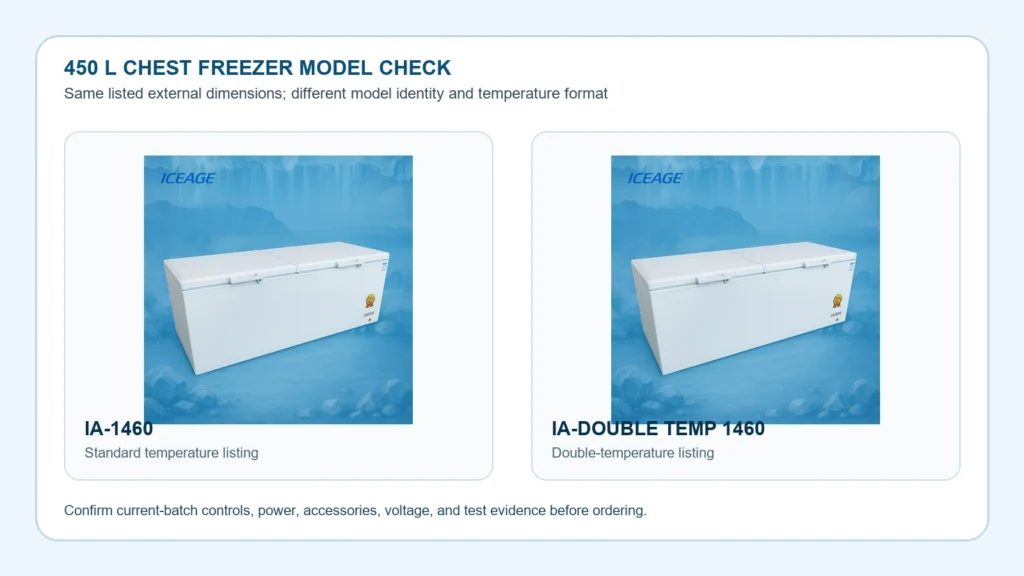
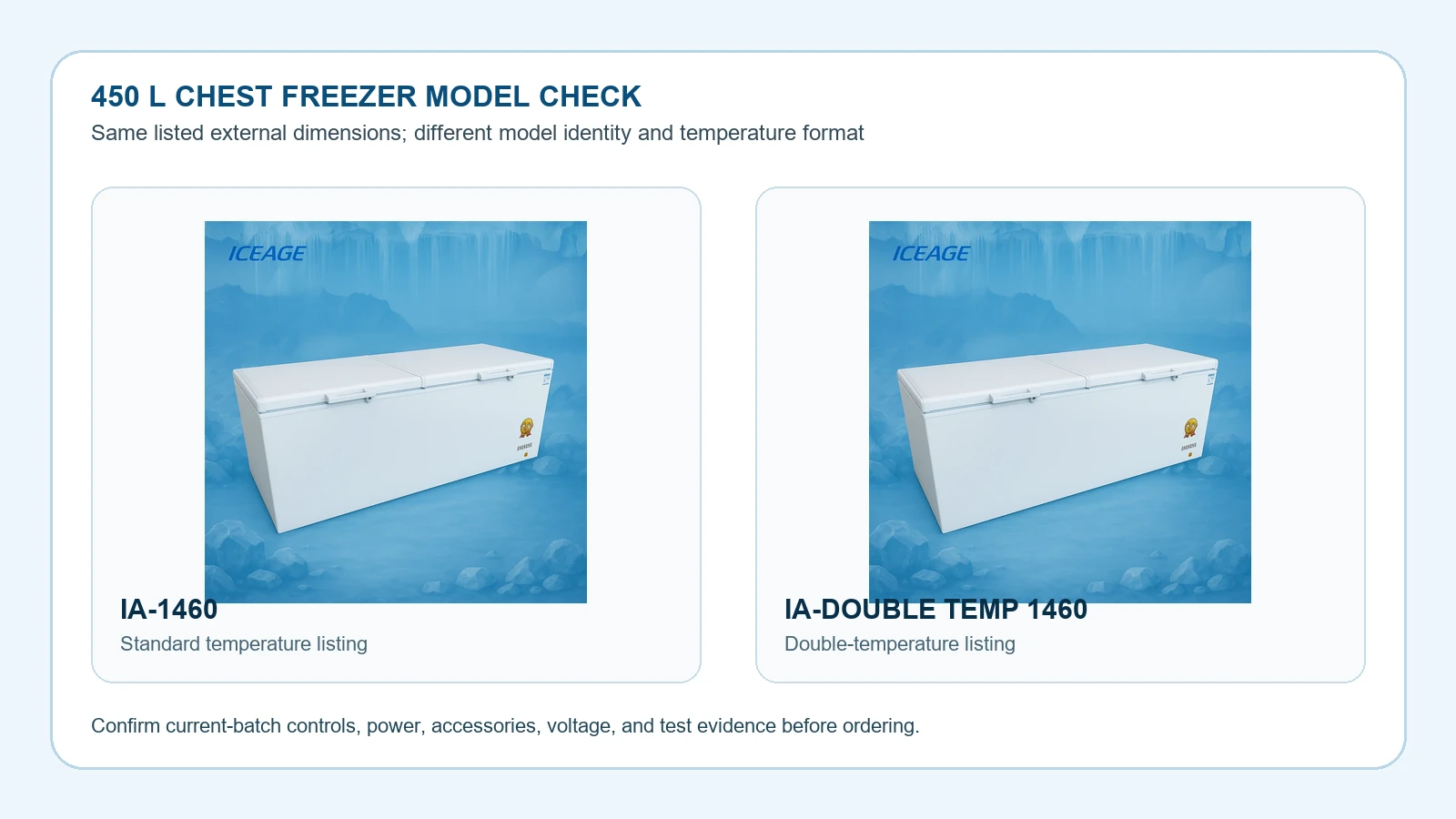
Choose IA-1460 when the customer needs one standard 450 L chest-freezer configuration and choose IA-DOUBLE TEMP 1460 only when two-temperature operation is a verified requirement. Both models are listed at 1460 × 730 × 900 mm and 450 L, but their model identity, temperature-control format, and listed input power differ. They should never share an unlabeled quotation row.
For a Ghana dealer, the safe sales process is to match each model to a real stock plan, then request the latest production-batch datasheet. The word “double temperature” is not enough to promise two independently adjustable compartments, a particular divider, or a per-zone temperature range. Those details need current drawings, controls evidence, and a witnessed sample test.
Compare the Listed Facts First
The current ICEAGE Chest Freezer product page lists eleven models and warns buyers to request the latest datasheet because specifications may vary by production batch. For the two 1460 models, the captured product record shows:
| Listed item | IA-1460 | IA-DOUBLE TEMP 1460 |
|---|---|---|
| Nominal capacity | 450 L | 450 L |
| External dimensions | 1460 × 730 × 900 mm | 1460 × 730 × 900 mm |
| Listed input power | 150 W | 95 W |
| Listed temperature entry | -24 to 0°C | -24 to 0°C, double-temperature model |
| Temperature format | Standard/single-temperature listing | Double-temperature listing |
These rows are a comparison starting point, not a purchase approval. The unusual difference in listed power makes the current datasheet especially important. Neither value should be “corrected” by assumption, and the lower number is not an energy-cost claim. Confirm voltage, frequency, refrigerant, plug, control arrangement, test conditions, and exact power for the quoted batch.
Both products belong to the same chest-freezer family, which is described as direct cooling with manual temperature control and top-opening construction. Glass-top and solid-door options are mentioned at family level. The quote must identify which door form and accessories apply to the selected model.
Define What the Customer Means by Two Temperatures
A dealer may hear “double temperature” and imagine several different uses: two frozen-food categories, chilled and frozen stock in one cabinet, a flexible compartment, or two independently set zones. The current model table confirms the IA-DOUBLE TEMP 1460 identity, but it does not establish all of those operating scenarios.
Turn the request into five written questions:
- How many physical compartments or controlled zones does the current model have?
- Does each zone have its own sensor, control, and setpoint, or does the model use another arrangement?
- What operating range is approved for each zone under the current datasheet?
- What divider, lid, basket, drain, and control-panel layout is supplied?
- Can both zones hold their specified temperatures at the same time under the supplier's stated test conditions?
If the customer only needs one frozen category at one operating setpoint, the standard IA-1460 may be the clearer choice. If the business case truly requires two temperature zones, the IA-DOUBLE TEMP 1460 should be released only after those five answers are evidenced.
The earlier double-temperature chest-freezer option guide explains the option at family level. This comparison has a narrower purpose: keep two same-size, 450 L model rows separate for a Ghana dealer's quotation and demonstration process.
Build the Choice From the Stock Plan
Start with products, pack sizes, target holding conditions, and replenishment pattern. List every category the shop expects to store, then have the operator or product owner state its required temperature. ICEAGE product content cannot decide the safe storage condition for meat, seafood, ice cream, beverages, medicine, or another regulated product.
Estimate how much usable separation the customer needs. Nominal 450 L capacity does not prove that every carton will fit or that the full volume is available around baskets, dividers, and required air space. Ask the customer for representative carton dimensions and daily stock levels. Use the current internal dimensions and basket drawing—when supplied—to test the facing and replenishment plan.
A useful dealer interview covers:
- product categories and required temperatures;
- cartons or tubs per category at peak stock;
- whether categories may share a temperature zone;
- how often each side will be opened;
- basket, divider, and lid preferences;
- available floor space and lid-opening clearance;
- delivery route, doorway, turn, and threshold constraints;
- site voltage, frequency, socket, earthing, and protection confirmed by a qualified electrician; and
- who will record temperatures and respond to an exception.
The Ghana focus is the buyer and delivery route, not an excuse to invent local voltage stability, ambient performance, or electricity cost. Record the actual site evidence for each customer.
Treat 95 W and 150 W as Datasheet Checks, Not Operating Cost
Listed input power is not the same as measured daily energy consumption. The 95 W and 150 W entries cannot predict a Ghana shop's bill without duty cycle, ambient conditions, lid openings, product loading, thermostat behavior, voltage quality, maintenance condition, and an agreed test method.
Use the values to identify a question, not to publish a savings percentage. Ask ICEAGE to reconfirm the nameplate power for the current production batch and provide any available energy-test method and result. If a dealer wants to compare running cost, meter actual approved samples under the same controlled loading and operating conditions.
Record start temperature, product simulant or load, ambient condition, thermostat setting, door openings, test duration, and meter identity. A one-hour no-load observation and a full-day store trial answer different questions. Neither result should be generalized to every customer site.
Electrical approval also needs the specified 220 V/50 Hz family reference checked against the destination order, along with plug customization and installation needs. The site electrician—not the cabinet brochure—approves the final circuit and protection.
Ask for a Zone-Proof Pack Before Ordering
For IA-DOUBLE TEMP 1460, the supplier evidence should make the two-temperature function visible and testable. Request:
- current model datasheet and model code;
- overall and internal dimension drawings;
- compartment, divider, lid, basket, and drain layout;
- control-panel image and operating manual;
- per-zone temperature range and test conditions;
- sensor/control relationship for each zone;
- nameplate and electrical specification;
- refrigerant and charge information where required for import/service; and
- sample test record showing both zones at the same time.
For IA-1460, request the same core pack but replace the two-zone evidence with one control and compartment map. That symmetry helps dealers compare quotations without giving the double-temperature model extra assumptions.
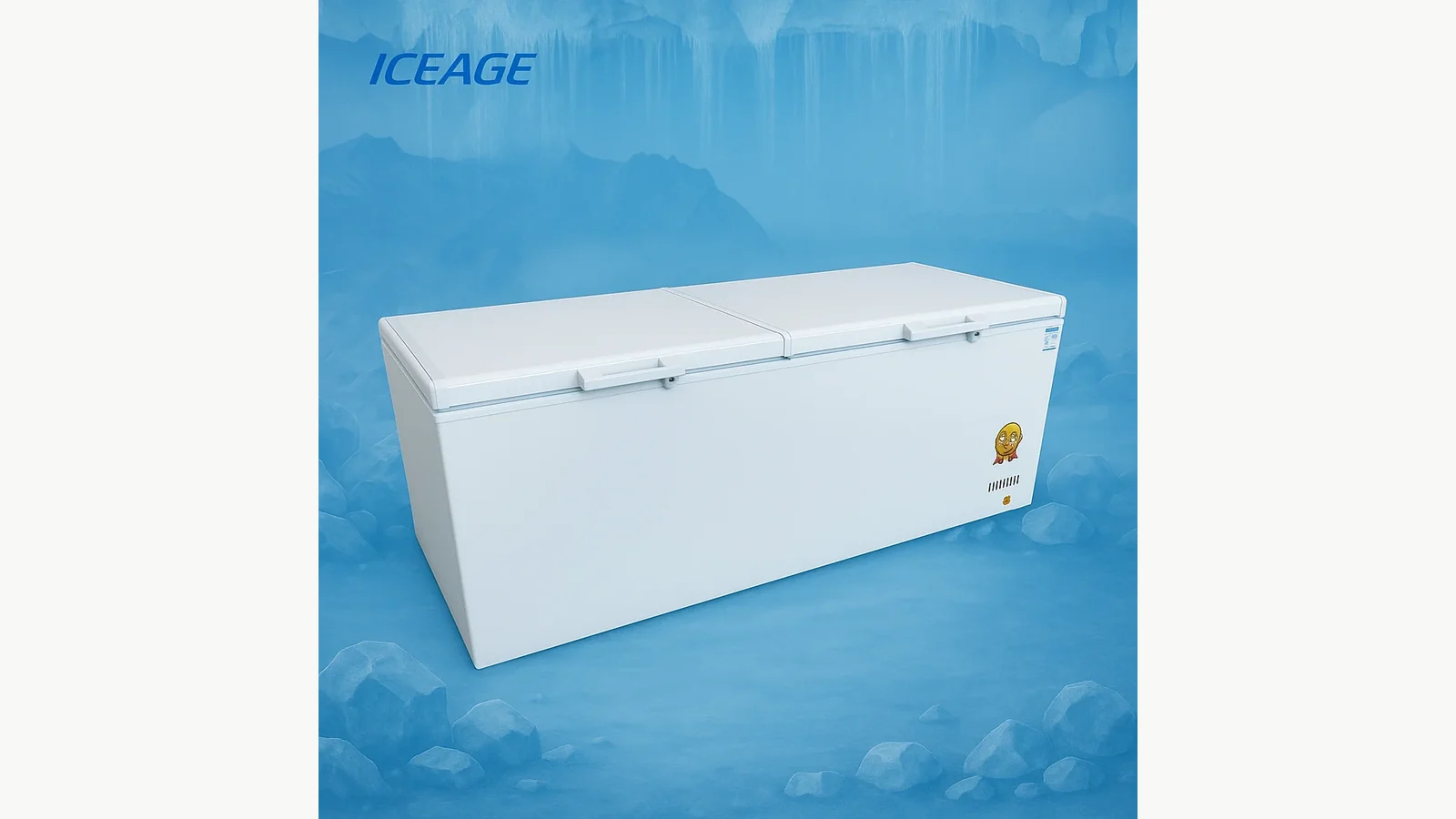
Photograph the model plate, controller, open cabinet, divider, baskets, lids, drains, and power connection during a sample review. Label every photo with the model and date. A stock image of a two-lid chest freezer does not prove the control architecture inside the quoted unit.
Demonstrate the Decision in a Ghana Showroom
A dealer demonstration should answer the customer's stock question, not simply show that the compressor runs. Set up representative packages or dimensioned dummy cartons. Mark which category belongs in which zone and why. Confirm that lids open fully in the proposed location and staff can reach baskets without moving the cabinet.
For the double-temperature sample, record both displayed or measured temperatures over an agreed observation period. Note thermostat settings, ambient condition, load, lid openings, and any recovery period. If only one display is present, ask how the second zone is monitored and controlled. An undocumented control system should never be explained from guesswork.
For the standard IA-1460, show how one setpoint supports the intended single-temperature stock group. If the customer begins asking for a second storage condition during the demonstration, stop and reopen the model decision rather than promising a use the approved configuration does not cover.
Keep the Models Separate Through Delivery and Service
Use the full model name on the quotation, purchase order, packing list, carton, warehouse location, and customer invoice. “1460 freezer” is ambiguous. A Ghana warehouse receiving both versions should use separate item codes and photograph the model plate before stock is put away.
Before dispatch, match the customer's order to the cabinet model, capacity, external dimensions, door form, baskets/dividers, control layout, voltage/frequency, plug, refrigerant documentation, serial number, and current manual. Confirm the delivery route with the packed dimensions and weight rather than the cabinet dimensions alone.
At installation and handover, record the final location, level, electrical check, initial pull-down observation, thermostat settings, zone labels, cleaning/defrost guidance, and customer acceptance. Service requests should start with the full model and serial number. Troubleshooting one model using the other model's control assumptions can waste time and obscure a genuine fault.
Related Reading
- IA-1760 vs IA-1960 vs IA-2000 for Ghana Site Fit helps dealers compare larger standard-capacity cabinets by actual route and site evidence.
- IA-2200 and IA-2500 Delivery Paths for Ghana Warehouses extends the receiving and route check for the largest listed models.
- Commercial Chest Freezer Procurement in Ghana provides the wider importer and dealer information checklist.
Send Two Separate RFQ Rows
Send ICEAGE the required product temperatures, stock mix, 450 L capacity need, quantity of each model, door form, basket/divider scope, Ghana destination, site electrical information, plug requirement, delivery route, branding, and documentation needs. Request separate IA-1460 and IA-DOUBLE TEMP 1460 quotations with current datasheets, zone/control evidence, nameplate power, packing dimensions, and a simultaneous zone-test plan before choosing.