
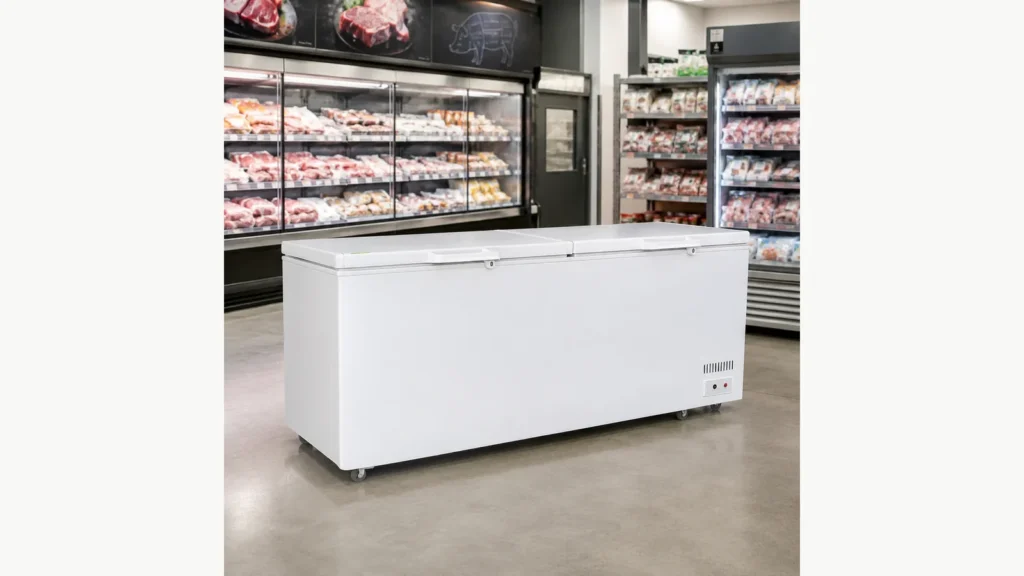
A small store does not automatically need the smallest freezer. The right capacity depends on the frozen assortment, delivery rhythm, usable floor area, lid-opening zone, stock rotation, and the path from the entrance to the final position. A cabinet that fits the sales floor but cannot pass the doorway is the wrong model. So is a larger unit that encourages deep, slow-moving stock the team cannot manage.
ICEAGE lists three useful starting points for smaller retail formats: IA-750 at 150 L, IA-990 at 250 L, and IA-1105 at 350 L. Their model numbers are not capacity labels. The approved product table and current datasheet should remain attached to every quotation and order.
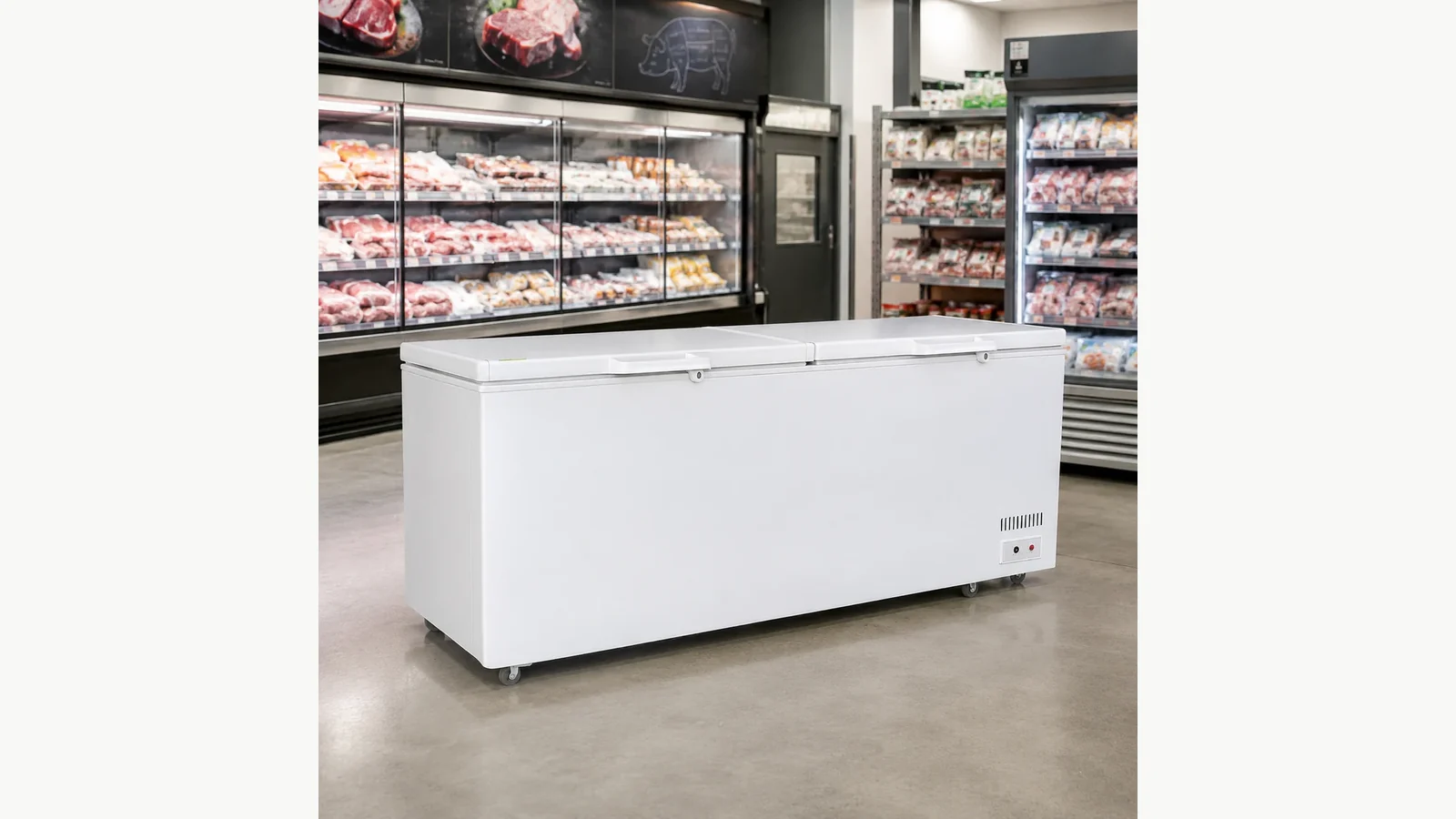
Compare the Three Listed Models First
The current commercial chest freezer product range records the following values:
| Model | Listed capacity | Listed power | Listed temperature range | Outside size (mm) |
|---|---|---|---|---|
| IA-750 | 150 L | 95 W | -20 to 0°C | 750 × 560 × 890 |
| IA-990 | 250 L | 95 W | -20 to 0°C | 990 × 560 × 890 |
| IA-1105 | 350 L | 95 W | -24 to 0°C | 1105 × 730 × 900 |
The manufacturer notes that specifications can vary by production batch. Use these listed values to build the comparison, then request the current datasheet for the quoted batch before releasing the purchase order. Packed dimensions and weights also need supplier confirmation; outside cabinet dimensions are not shipping dimensions.
The step from IA-750 to IA-990 adds listed capacity and cabinet length while keeping the recorded depth and height the same. The step to IA-1105 changes the comparison more substantially: it adds length, increases depth from 560 to 730 mm, adds 10 mm to the listed height, and changes the listed range from -20–0°C to -24–0°C.
That is why a capacity choice is also a footprint and specification choice.
Build the Capacity From the Real Stock Plan
Start with the products the store expects to carry. List each frozen category, case-pack quantity, pack dimensions, delivery frequency, minimum display or safety stock, and target days of stock. Add room for baskets, dividers, packaging variation, and safe air circulation according to the current manufacturer guidance.
A 150 L IA-750 can be evaluated for a focused assortment or low stockholding where frequent replenishment is reliable. It may fit a compact sales area, a checkout-adjacent frozen offer, or a back-up stock role. The selection still needs enough usable organization for the actual packs.
A 250 L IA-990 adds 100 L of listed capacity and 240 mm of cabinet length while retaining the same listed depth and height as IA-750. That can be attractive when the store needs more facings or buffer stock but has a narrow aisle or doorway that favors the 560 mm cabinet depth.
A 350 L IA-1105 offers another 100 L over IA-990 and belongs to a different dimensional step. Its listed 730 mm depth matters in small stores, where a 170 mm change can affect aisle circulation, doorway turns, counter spacing, and staff reach. The capacity can support a wider assortment, but it earns its floor space only if stock turnover and access justify it.
The published guide on chest freezer model and capacity documentation for importer reorders shows how to keep these model values tied to repeat-order records.
Use Exterior Dimensions to Test the Store, Not Estimate Volume
Draw each cabinet as a rectangle at the listed outside size. Add the lid-opening envelope from the current model drawing, the user's standing position, trolley or basket movement, nearby shelving, wall projections, sockets, and the route used to clean around the unit.
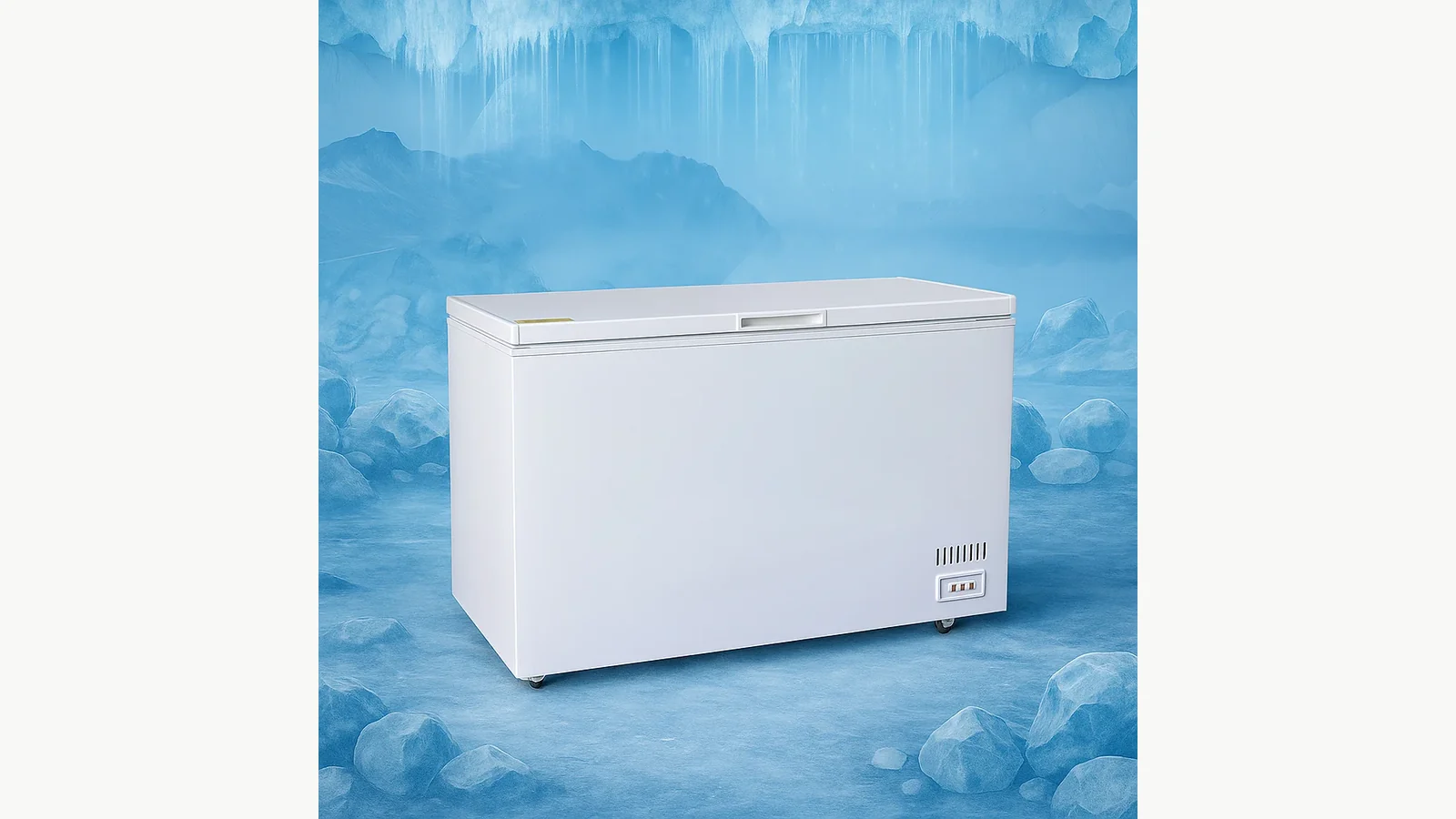
For IA-750 and IA-990, the recorded 560 mm depth can be the key fit advantage. Their different lengths allow a store to compare floor frontage without changing depth. IA-1105 needs a separate plan test because the 730 mm depth changes the body position and aisle relationship.
Avoid subtracting insulation from outside dimensions to estimate usable volume. The listed capacity is the product reference; internal baskets, cabinet geometry, and the current datasheet determine usable organization. Likewise, an outside width cannot prove doorway fit by itself. Measure the entire route, including door clear opening, handles, thresholds, corridor corners, lift doors, ramps, and any point where the unit has to turn.
Ask the supplier for packed dimensions, packed weight, handling orientation, and any transport restrictions before planning delivery. The installer or logistics team should confirm the movement method and floor conditions.
Keep the Temperature Difference Visible
IA-750 and IA-990 have a recorded -20 to 0°C range. IA-1105 has a recorded -24 to 0°C range. This distinction belongs on the comparison sheet, but it is not a reason to assume one cabinet is automatically better for every frozen product.
Match the required storage condition to the food supplier's storage guidance, local rules, operating practice, and the cabinet's current approved datasheet. Setpoint, loading, ambient conditions, lid opening, product temperature at loading, and maintenance all influence actual operation. A listed range is not a product-temperature guarantee under every store condition.
The -40°C value recorded elsewhere in the ICEAGE range belongs only to the special IA-1110 model. It has no place in a 150/250/350 L comparison.
Compare Delivery Rhythm and Stock Accessibility
Small stores often have limited back-room capacity, so the sales-floor freezer may carry both display and reserve stock. A larger cabinet can reduce replenishment frequency, but deeper layers can make rotation harder. Build a weekly scenario for each model:
- opening stock by category;
- delivery quantity and day;
- expected daily sales;
- number and position of baskets or dividers;
- refill time and lid-open events;
- space needed for new stock before rotation;
- slow-moving packs that could become hidden.
For a focused 150 L offer, one or two clearly defined product groups may be easier to control than a broad mixed assortment. At 250 L, the extra length can support additional basket zones or facings. At 350 L, the team needs a deliberate map so the added capacity does not become an unrecorded bottom layer.
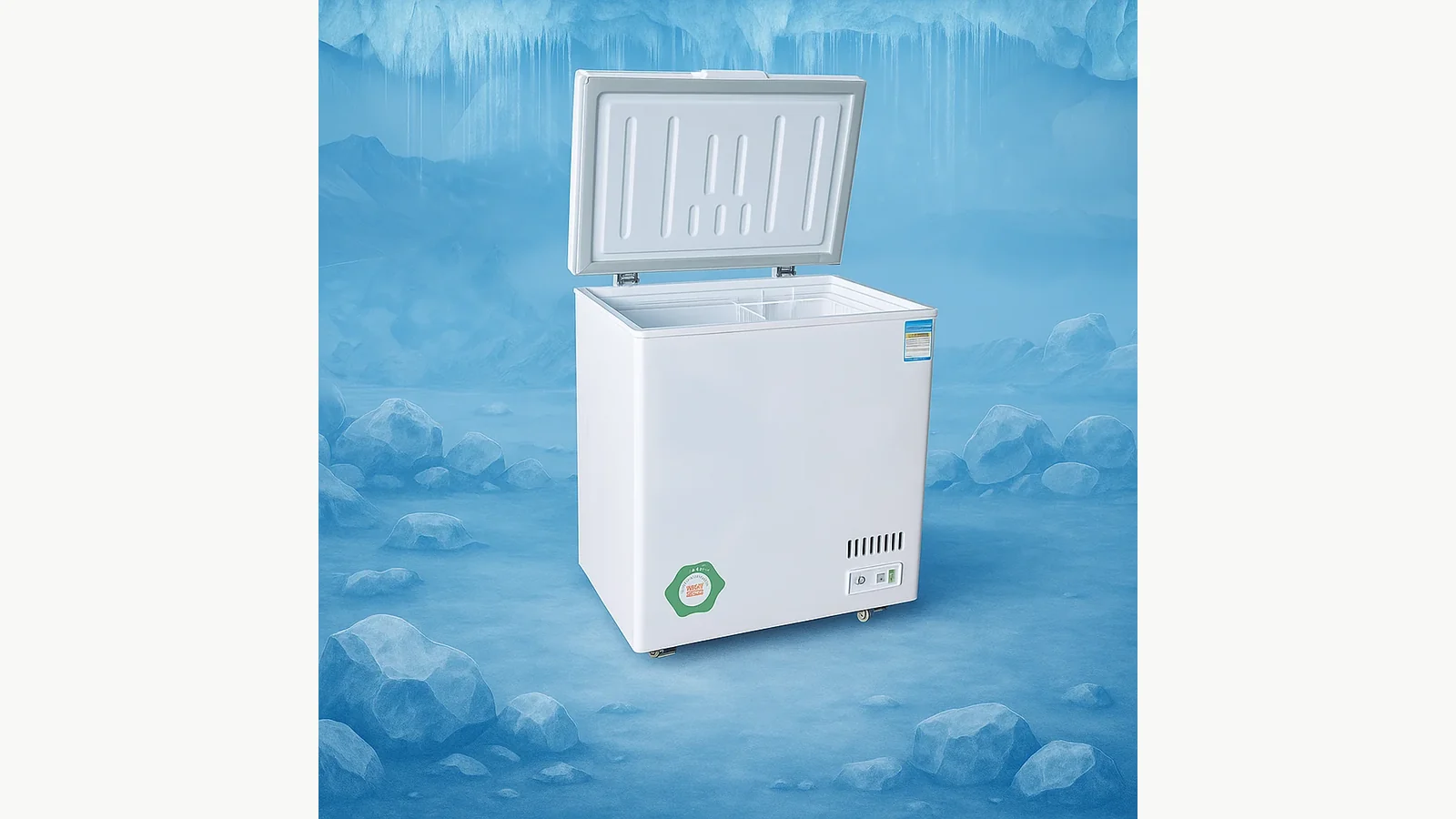
Use category labels and a refill sequence. New stock should enter according to the store's approved rotation method, and staff should be able to reach each zone without removing unrelated products. Basket and divider availability needs confirmation for the exact quoted model.
Check Lid Clearance and Staff Reach
Top-opening cabinets need vertical and user space as well as floor space. Record any counter overhang, wall shelf, sign, hanging display, window ledge, or blind that could obstruct the lid. Confirm the exact lid geometry and required clearance from current product drawings rather than inventing an allowance.
Ask a representative staff member to stand at the proposed position on a taped floor outline. Check reach to the planned basket zones while preserving safe, stable posture and store procedures. The 730 mm listed depth of IA-1105 deserves particular attention if the cabinet sits near a counter, wall, or narrow aisle.
The guide to planning chest freezer lid-opening clearance in a small store provides the detailed site exercise. Add those results to the model comparison instead of treating clearance as an installation problem to solve after delivery.
Score the Models Against the Same Evidence
A simple decision sheet prevents capacity from dominating the choice. Give each model the same evidence fields:
- listed model, capacity, outside size, power, and temperature range;
- current datasheet revision;
- planned categories and peak stock quantity;
- delivery and stock-rotation scenario;
- floor-plan fit and aisle effect;
- complete delivery-path check;
- lid-opening and staff-reach check;
- basket, divider, lock, drain, and accessory requirements where applicable;
- voltage, frequency, plug, and destination details;
- packed size, weight, warranty terms, spare-parts route, and supplier exclusions.
Mark every item confirmed, pending, or not applicable. A model wins only when the evidence supports both daily operation and procurement.
Put the Exact Model on the RFQ
Send the supplier the chosen candidate model or models, quantity, destination, voltage and frequency, plug requirement, frozen categories, required storage condition, delivery path, site photos, body color or logo request, basket and divider needs, packaging, and requested inspection documents.
If the store is still comparing IA-750, IA-990, and IA-1105, ask for three separate quotation rows. Each row should show current capacity, outside size, temperature range, power, packing data, included accessories, customization, lead time, and datasheet revision. This prevents a general “250–350 L freezer” request from becoming an unapproved substitution.
For a tightly focused range and very limited floor area, IA-750 may be the sensible starting point. IA-990 is the middle step when added length and stock capacity help while 560 mm depth remains useful. IA-1105 fits a broader stock plan only when the store can accept its larger listed length and depth and needs its recorded specification. The final choice belongs to the evidence, not the round capacity number.
Related Reading
- How to Choose a Commercial Chest Freezer for Retail Stores places this three-model comparison in the broader purchase process.
- Chest Freezer Basket and Divider Options for Retail Display helps turn selected capacity into accessible product zones.
- Chest Freezer Receiving Inspection After Transit closes the model identity and condition check at delivery.