
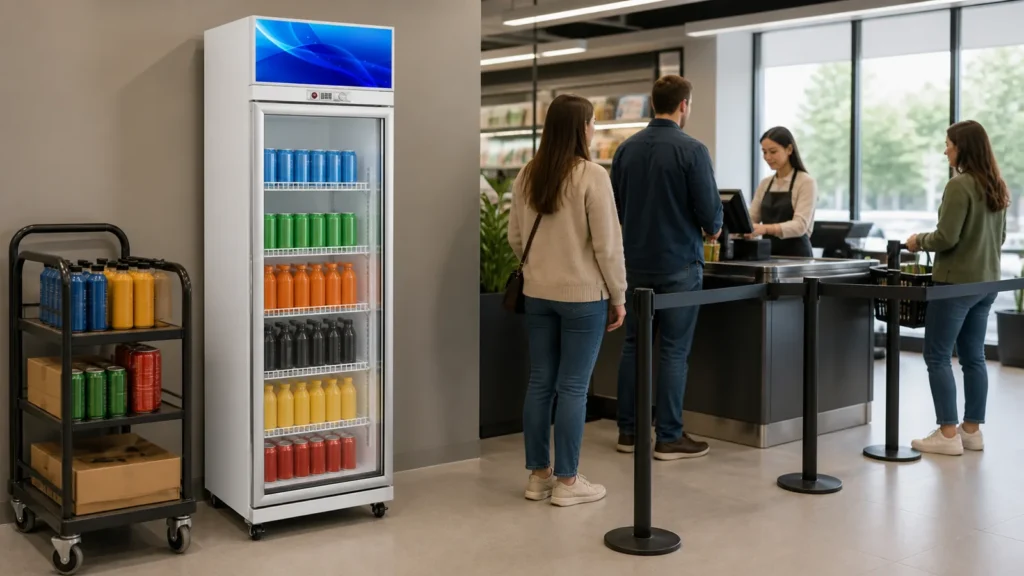
A beverage cooler near checkout can place chilled drinks in a convenient customer path, but the cabinet also adds a door swing, shopper pause, basket movement, replenishment trolley, electrical connection, cleaning boundary, and service route to the smallest operating zone in the store. A floor plan that shows only the cooler footprint misses most of that interaction.
The layout review should be performed as a sequence. A shopper joins the queue, chooses whether to step toward the cooler, opens the glass door, selects a product, closes the door, returns to the payment path, and carries a basket or cart through the same space. Staff must replenish and clean without cutting through the queue. Those movements become the basis for placement rather than a promise about impulse sales.
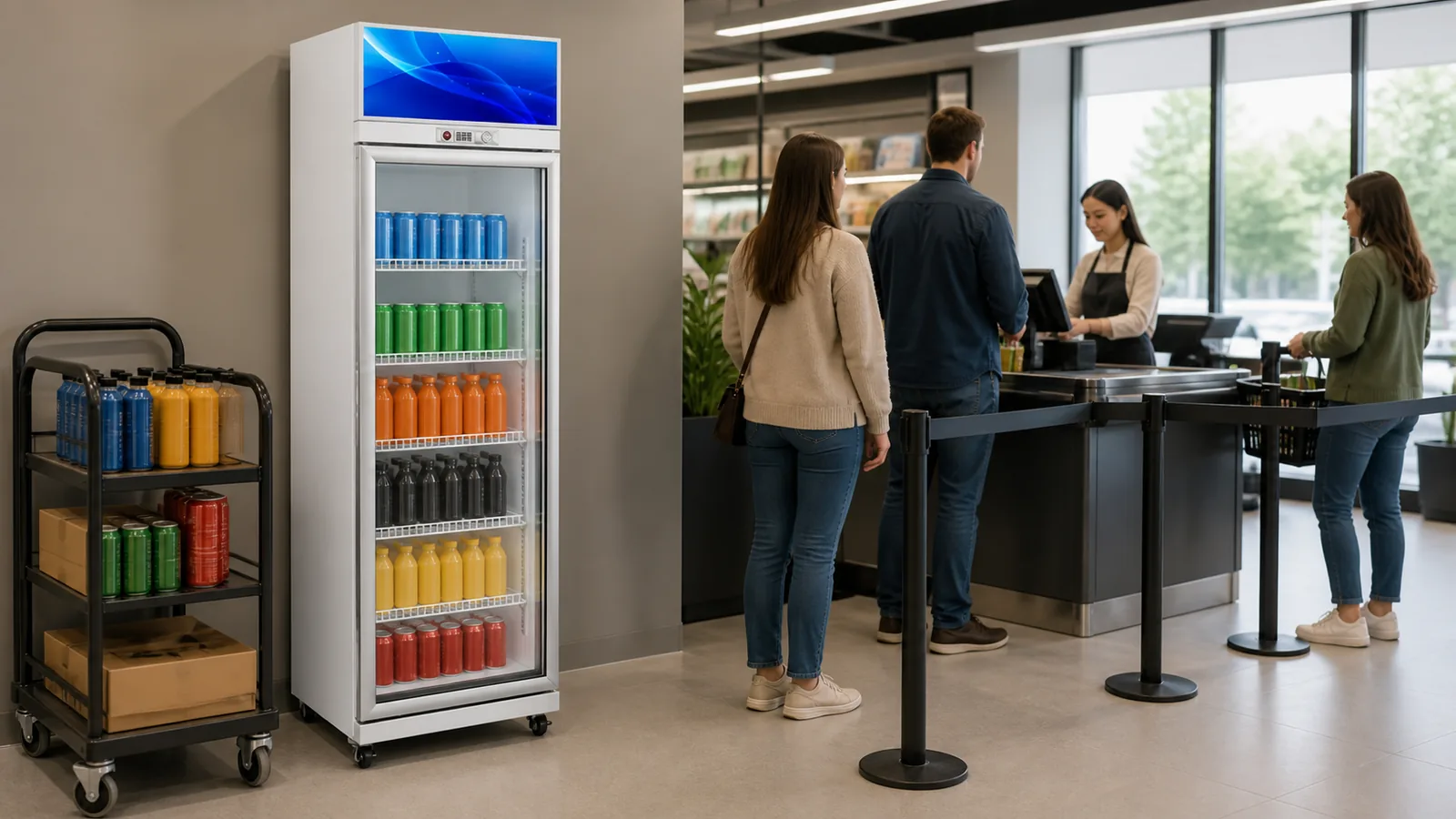
Draw the Queue as a Moving Path
Record entry, waiting positions, payment point, exit, basket return, and peak operating shape. The working record for this stage covers queue entry, waiting line, checkout counter, payment position, exit path, basket or cart return, and nearby doorway.
Records for this stage
- queue entry: source, location, owner, status, and date.
- waiting line: source, location, owner, status, and date.
- checkout counter: source, location, owner, status, and date.
- payment position: source, location, owner, status, and date.
- exit path: source, location, owner, status, and date.
- basket or cart return: source, location, owner, status, and date.
Why this stage can fail: Placing the cabinet in unused-looking floor area that becomes occupied when the queue bends or grows. Use queue entry, waiting line, and checkout counter to document the exception, and keep payment position with the reviewer's decision.
Release condition: The plan shows normal and busy queue shapes and keeps required circulation boundaries visible. Record any exception against basket or cart return, name its owner and next action, and keep nearby doorway open until resolved.
Overlay the Cooler Footprint and Door Movement
Use the selected model drawing to add cabinet depth, door swing, handle reach, and user standing zone. The working record for this stage covers model identity, cabinet footprint, door hinge side, open-door envelope, handle location, shopper standing point, and wall or fixture clearance.
Records for this stage
- model identity: source, location, owner, status, and date.
- cabinet footprint: source, location, owner, status, and date.
- door hinge side: source, location, owner, status, and date.
- open-door envelope: source, location, owner, status, and date.
- handle location: source, location, owner, status, and date.
- shopper standing point: source, location, owner, status, and date.
Why this stage can fail: Checking the closed cabinet only and discovering that the door or shopper blocks payment and exit movement. Use model identity, cabinet footprint, and door hinge side to document the exception, and keep open-door envelope with the reviewer's decision.
Release condition: A user can approach, open, select, and leave without entering the cashier or queue-control area. Record any exception against shopper standing point, name its owner and next action, and keep wall or fixture clearance open until resolved.
Protect Cashier Sightlines and Controls
Review whether the cooler, open door, stocked display, and waiting shoppers obscure important store views. The working record for this stage covers cashier eye position, entrance view, queue view, payment area, low and high shelf product, promotional header, and security boundary.
Records for this stage
- cashier eye position: source, location, owner, status, and date.
- entrance view: source, location, owner, status, and date.
- queue view: source, location, owner, status, and date.
- payment area: source, location, owner, status, and date.
- low and high shelf product: source, location, owner, status, and date.
- promotional header: source, location, owner, status, and date.
Why this stage can fail: Using an empty elevation that does not represent the stocked cooler or an open door. Use cashier eye position, entrance view, and queue view to document the exception, and keep payment area with the reviewer's decision.
Release condition: The operating view remains acceptable to the store manager with the cabinet loaded and door in use. Record any exception against promotional header, name its owner and next action, and keep security boundary open until resolved.
Plan Replenishment Outside the Customer Conflict
Set a route, trolley position, stock quantity, and timing that allow staff to work without occupying the queue. The working record for this stage covers backroom route, trolley footprint, carton opening point, shelf map, empty packaging, replenishment window, and staff owner.
Records for this stage
- backroom route: source, location, owner, status, and date.
- trolley footprint: source, location, owner, status, and date.
- carton opening point: source, location, owner, status, and date.
- shelf map: source, location, owner, status, and date.
- empty packaging: source, location, owner, status, and date.
- replenishment window: source, location, owner, status, and date.
Why this stage can fail: Opening outer cartons beside the checkout while customers step around stock and waste. Use backroom route, trolley footprint, and carton opening point to document the exception, and keep shelf map with the reviewer's decision.
Release condition: Staff can replenish and remove packaging through a defined route and operating window. Record any exception against replenishment window, name its owner and next action, and keep staff owner open until resolved.
Keep Cleaning, Power, and Service Reachable
Coordinate the actual power point, cable route, floor cleaning, condensate care when applicable, and service access for the chosen model. The working record for this stage covers power location, protected cable route, plug access, cleaning edge, drip or condensate component per model, ventilation boundary, and service route.
Records for this stage
- power location: source, location, owner, status, and date.
- protected cable route: source, location, owner, status, and date.
- plug access: source, location, owner, status, and date.
- cleaning edge: source, location, owner, status, and date.
- drip or condensate component per model: source, location, owner, status, and date.
- ventilation boundary: source, location, owner, status, and date.
Why this stage can fail: Hiding a connection behind fixed checkout joinery or allowing queue hardware to become a permanent service obstruction. Use power location, protected cable route, and plug access to document the exception, and keep cleaning edge with the reviewer's decision.
Release condition: Connections and service boundaries match the model documentation and remain accessible after checkout fixtures are installed. Record any exception against ventilation boundary, name its owner and next action, and keep service route open until resolved.
Checkout Cooler Movement Test
Test every user and staff movement against the operating cabinet rather than evaluating the closed footprint alone.
| Review Point | Evidence to Keep | Release Question |
|---|---|---|
| Draw the Queue as a Moving Path | queue entry, waiting line, checkout counter, and payment position | the plan shows normal and busy queue shapes and keeps required circulation boundaries visible. |
| Overlay the Cooler Footprint and Door Movement | model identity, cabinet footprint, door hinge side, and open-door envelope | a user can approach, open, select, and leave without entering the cashier or queue-control area. |
| Protect Cashier Sightlines and Controls | cashier eye position, entrance view, queue view, and payment area | the operating view remains acceptable to the store manager with the cabinet loaded and door in use. |
| Plan Replenishment Outside the Customer Conflict | backroom route, trolley footprint, carton opening point, and shelf map | staff can replenish and remove packaging through a defined route and operating window. |
| Keep Cleaning, Power, and Service Reachable | power location, protected cable route, plug access, and cleaning edge | connections and service boundaries match the model documentation and remain accessible after checkout fixtures are installed. |
Checkout Placement Checklist
- Draw normal and busy queue paths, payment positions, exits, and basket returns.
- Add the exact cabinet footprint, hinge side, door swing, handle reach, and shopper standing zone.
- Review cashier sightlines with shelves stocked and the door open.
- Keep trolley staging, carton opening, shelf filling, and waste removal outside the live queue.
- Verify power, cable, cleaning, ventilation, and service access against the selected model documentation.
Checkout Beverage Cooler Questions
Should the door open toward or away from the queue?
Test both the selected hinge arrangement and the actual shopper path. The model options, handle reach, adjacent fixtures, and replenishment side determine the practical choice.
Can promotional graphics improve the location?
Graphics can support category communication, but they should not obscure product view, required labels, handles, controls, cashier sightlines, or functional areas.
How should staff test the plan?
Mark the cabinet and door envelope on the floor, use the real baskets or carts, walk shopper and replenishment sequences, and record conflicts before fixing the layout.
Related Product or Reading
- Beverage cooler range: provides the real cabinet scope for model selection
- Commercial chest freezer selection: offers a separate frozen-food storage option when the store also needs horizontal frozen capacity
Test the Checkout Layout
Share the selected cooler model, store plan, queue shapes, hinge side, door envelope, shopper and cashier positions, basket type, replenishment route, power point, cleaning boundary, and service access with ICEAGE. That project evidence lets ICEAGE review the selected one-door glass beverage cooler for this buyer task: Help small-supermarket operators test whether a one-door beverage cooler can support checkout merchandising without obstructing queue and store workflows.