
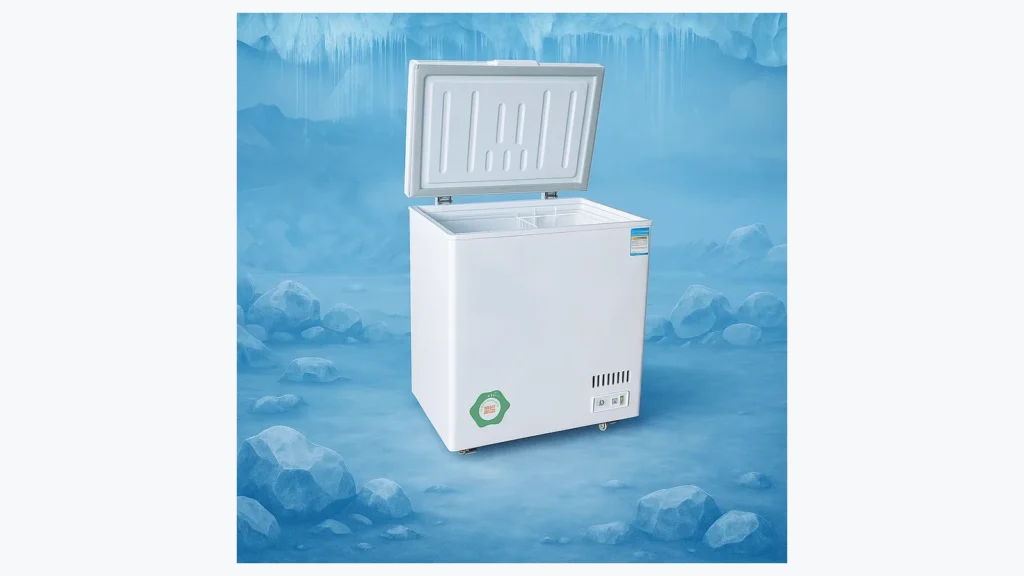
A chest freezer holds more than frozen product. It holds a store's paid-for stock, sitting at a low height where a lid is easy to open and easy to forget. For a convenience store, frozen food shop, or small supermarket, the lid is the main access point, and controlling that access is as much a stock-accounting decision as it is a hardware decision. A store that locks its freezer is protecting margin, and a store that locks it without a key routine has only moved the problem from the lid to the key.
This guide is written for a retail buyer who wants to understand what a lockable lid option involves on a commercial chest freezer and how a store manages the keys once the lock is in place. It covers the lock options a buyer should confirm, the key register and staff handoff that keep keys accounted for, the model confirmation that stops the wrong lock being ordered, and the order questions that belong on the quotation.
Why lid security is a store decision first
Lid security matters for the quiet reasons that never make a headline. Between closing and opening, the freezer sits unattended, and the lid is the only thing between the store and anyone who opens it. During the day, a lock changes who can reach into the cabinet, which matters when staff are rotating or when high-value stock sits near the top. A lock is also a way to make stock movement traceable: when only one or two people hold the keys, the store knows who opened the cabinet and when.
None of that requires a specific lock design. It requires the store to decide, before buying, that the lid will be controlled, and then to buy and operate the freezer accordingly. The decision belongs at the ordering stage because adding a lock after the cabinet is on the floor is a retrofit question, not a factory option.
What "lockable lid" can mean on a chest freezer
The lockable lid is a detail a buyer confirms rather than assumes. Commercial chest freezers differ from model to model, and the chest freezer range spans model codes such as IA-750, IA-990, IA-1105, IA-1460, IA-1760, IA-1960, IA-2000, IA-2200, and IA-2500, with capacities from 150 L to 1300 L. A lock treatment is not a single standard across all of them, which is exactly why the buyer asks instead of guessing.
The questions that settle it are straightforward. Does this model offer a lockable lid, and is it standard or an added option? Is the lock built into the lid itself, or does the cabinet use a separate hasp or padlock point? How many keys are supplied with the unit, and can more keys be ordered later? How is the lock fitted, and does it change how the lid opens and closes? Each answer comes from the supplier for the specific model, because none of it is safe to read off a generic description.
The chest freezer page lists the customization directions the supplier already supports — logo sticker, body colour, voltage and plug, packaging, temperature range, and basket or divider options, alongside OEM and ODM work. A lock option sits inside that same conversation: it is a model-specific detail to confirm on the quotation, not a feature every cabinet carries by default.
Confirm the option against the model before ordering
The model confirmation is where a lock order goes right or wrong. A buyer who asks for "a lock" without naming the model leaves room for the lock to arrive for the wrong cabinet, and a buyer who names the model but not the capacity can hit the same problem, because the range runs from 150 L to 1300 L across distinct model codes. The order line therefore carries the model code, the capacity, and the lock detail together, so the supplier can match all three.
The confirmation also settles the temperature picture. Standard temperature examples across the range include -20 C to 0 C and -24 C to 0 C, and the deep-freezer IA-1110 at 358 L and -40 C to 0 C is its own cabinet. A lock confirmed for one model is a lock confirmed for that model's lid, not a universal part that travels across the range. The buyer checks the nameplate on the unit being ordered and confirms the lock applies to that exact cabinet.
Build a key register from the first day
Key control is a store routine, and it starts the moment the keys are handed over. The store numbers each key and records it in a simple register: which key number, which cabinet, and which person holds it. Spare keys are stored separately from the working keys, and the register notes where the spares live. A numbered register turns "the key is lost" into "key three of cabinet one is missing", which is a much smaller problem to fix.
The register also records who signs a key out and back in. A store where keys float between staff members on a handshake is a store where a key goes missing and no one notices until the lid needs opening. Signing keys out and back in costs a few seconds a day and removes the guessing when a key is unaccounted for.
The register also gives the store a ready answer when a cabinet changes hands. If a freezer is sold, moved between stores, or returned to the distributor, the keys are transferred through the register rather than handed over in a pocket, so the record of who holds what stays whole. A key that is not on the register is a key the store treats as missing, and the missing key is logged the moment it is noticed rather than the moment it is needed.
Staff handoff at open and close
The open-and-close handoff is where the lock actually does its job. At close, the named person locks the lid, checks it is seated, and records that the cabinet is locked and the keys returned to the register. At open, the next person takes the key, unlocks, and records the handover. The routine is short, but it ties the lock to a person at every change of shift.
The handoff also covers a missing key. When a key is not in the register, the store treats it as lost rather than waiting, because a lost key that might have been copied is a security question, not just a convenience question. The replacement path is a supplier question — how to obtain a new key or re-key the lid for that model — and it goes through the same model confirmation as the original order.
Order questions that belong on the quotation
A lockable lid order is complete when the quotation answers a short set of questions. Is the lockable lid standard or optional on this model? Is the lock integrated into the lid or a separate padlock point, and what is supplied with it? How many keys come with the unit, and can additional keys or a replacement key be ordered? Does the lock sit on the lid itself or on the cabinet body, and does it change the lid's opening or closing? Each of these is a supplier answer for the specific model, and each one removes a surprise that would otherwise appear after delivery.
The lock detail sits inside a wider buying decision, and the commercial chest freezer buying guide for retail stores covers the full model and feature choice of which this lid-security option is one part. For the day-to-day practice that keeps a lid working well after the cabinet arrives, the chest freezer lid closure check article covers the routine of confirming the lid is properly shut after restocking, and the receiving inspection guide covers checking the lid and cabinet when the unit first lands.
A short order checklist for the lock option
Five confirmations settle a lockable lid order before it is placed. First, the model code and capacity sit on the order line, because a lock confirmed for the wrong cabinet arrives and fits nothing. Second, the store confirms whether the lockable lid is standard or an added option on that model, so the quotation reflects what is actually being bought rather than what the store hoped was included. Third, the store asks whether the lock is integrated into the lid or a separate padlock point, and what is supplied with it, so the delivery matches the plan on the floor. Fourth, the store confirms how many keys come with the unit and whether additional or replacement keys can be ordered later, because that answer shapes the key register before the first shift begins. Fifth, the store asks whether the lock changes how the lid opens and closes, so the staff know exactly what they are handling when they lock and unlock the cabinet. Each line is a supplier answer for the specific model, and together they turn a lock option from an assumption into a confirmed order detail that travels with the purchase.
Related reading
The lockable lid is one decision inside the wider purchase, and the full product index shows the two equipment lines a retail buyer plans across. For anything that needs a model-specific answer, the team can be reached through the contact page.