
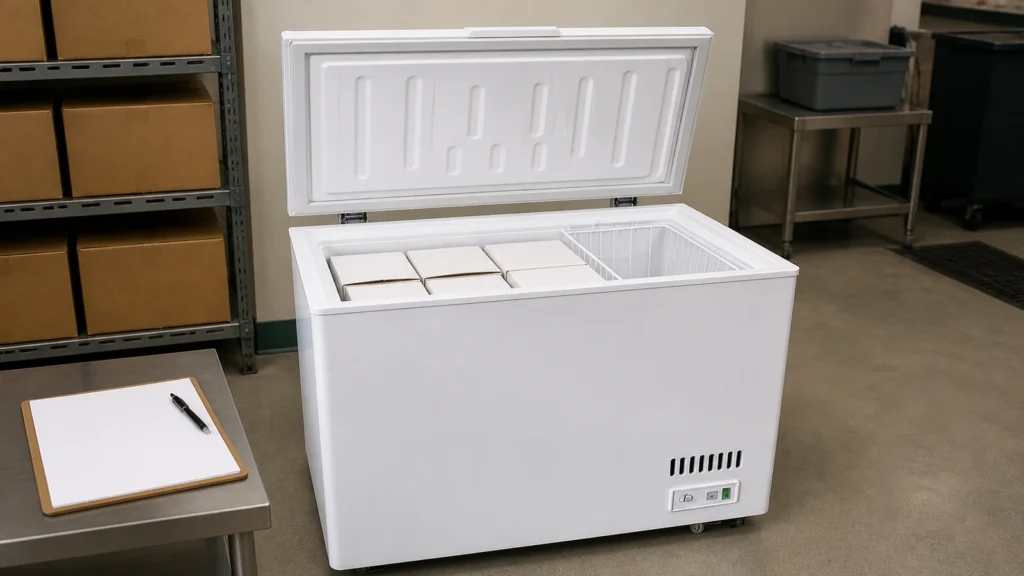
A chest-freezer lid that closes normally when empty may stay raised after restocking. A tall package, shifted basket, ice at the rim, loose label, damaged seal, hinge issue, or cabinet condition may be involved. Store staff can preserve useful evidence without forcing the lid or guessing which component failed.
This guide concerns an ICEAGE commercial chest freezer for frozen products. It is not a beverage cooler.
Record the First Condition
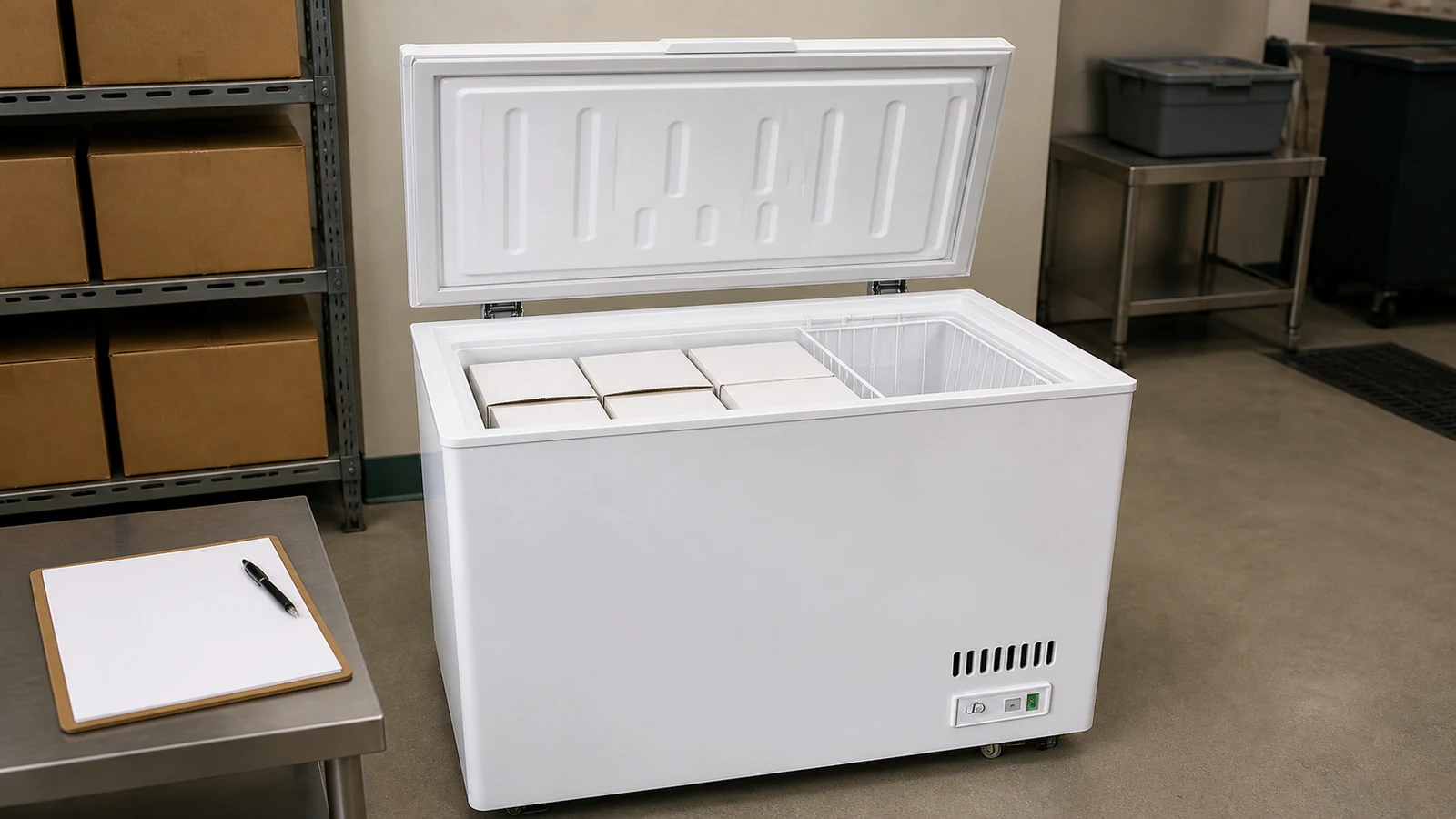
Photograph the entire freezer, open lid, product load, rim, hinges, and exact area where closure stops. Record model, unit location, time, restocking activity, staff present, and whether the condition appeared suddenly or gradually.
Avoid pushing the lid down for the first photograph. A forced closure can damage packaging, lid, seal, hinge, or cabinet and remove evidence of the obstruction.
Keep customers away from an unstable or partially open lid under the store's safety procedure.
Protect Frozen Products
Follow the retailer's food-safety and temperature-control plan. If products need to move, use approved temporary frozen storage and record movement times and batches.
The visual lid condition does not establish product temperature. Use the store's approved monitoring and disposition criteria.
Assign one person to manage product location so the loading pattern remains understandable during inspection.
Map the Loading Arrangement
Photograph the freezer by zones before moving products. Record baskets, dividers, product categories, package heights, loose bags, cartons, and items touching the rim or lid interior.
| Loading Zone | Record |
|---|---|
| Top baskets | Position, height, product, movement |
| Lower storage | Package stacks and protrusions |
| Divider areas | Alignment and product crossing boundaries |
| Rim zone | Labels, bags, frost, debris, package contact |
| Lid interior | Visible contact marks or loose parts |
Use the basket and divider article for organization planning, while the actual model manual controls loading limits.
Remove Obvious Loose Obstructions Safely
Under the store procedure, move only clearly loose products, labels, bags, or baskets that interfere with the closure path. Photograph before and after each change.
Avoid pressing packages deeper without knowing the approved loading boundary. Repacking can block internal areas or damage product.
If the lid still resists after visible loose items are removed, stop and document the remaining contact point.
Inspect Baskets and Dividers
Check whether baskets sit in their intended supports and whether dividers are displaced, bent, overfilled, or carrying weight in an unapproved way. Record accessory identity and position.
Avoid forcing a basket beneath the lid. Remove and inspect it under the approved method if needed.
Keep accessories tied to the correct freezer when several units are restocked together.
Check Rim and Seal Condition
Inspect the rim for packaging fragments, labels, ice, dirt, cleaning cloths, loose trim, and visible damage. Photograph the full perimeter and close details.
View the seal for cuts, displacement, contamination, hard folds, or sections pulled from position. Avoid stretching, gluing, heating, or adjusting it outside supplier guidance.
Clean only through the model and store procedure, then record the result.
Observe Hinges and Lid Travel
From a safe position, watch both sides as the lid moves through its normal path. Record uneven movement, noise, contact, looseness, damaged covers, or a lid that will not stay in an expected position.
Avoid dismantling hinge or balance components. Stored force and heavy lids can create injury risk. Qualified service handles unresolved mechanical conditions.
The lid-opening clearance article covers external conflicts with walls and shelves. Include those surroundings in the check.
Separate Ice From Other Obstructions
Record visible ice location and whether it follows the rim, seal, one corner, or product contact. Note the last approved defrost and cleaning event.
Use the manual defrost workflow when the store's approved plan calls for defrosting. Avoid chipping or heating ice through improvised methods.
Photograph the baseline after the approved process and note whether the closure issue returns.
Test Normal Closure Without Force
After authorized visible corrections, lower the lid through normal movement. Record where resistance begins and whether the full perimeter meets as expected.
Avoid adding body weight, temporary latches, or objects on top. A lid that requires force deserves service review.
Keep hands and products clear of pinch points.
Build a Recurrence Timeline
Record closure before restocking, during loading, immediately after, and after trading periods. Note which product or basket changes coincide with the condition.
Use the same camera positions. A repeatable timeline helps separate a loading event from a persistent cabinet condition without declaring a cause.
Include recent cleaning, relocation, maintenance, or impact.
Escalate With Model-Specific Evidence
Send model, unit ID, loading map, basket positions, rim and seal photos, hinge observations, first occurrence, changes made, recurrence, cleaning or defrost history, and any product-control concern.
Use factual wording. "Lid remains approximately open at the front-right after Basket B is installed" is more useful than "hinge broken" when the component has not been assessed.
Qualified service and supplier documentation determine repair or adjustment.
Related Reading
- Chest Freezer Basket and Divider Options supports organized loading.
- Chest Freezer Lid-Opening Clearance checks walls, shelves, and external movement.
Common Questions
Can staff push the lid closed over tall packages?
Avoid force. Protect products, preserve the loading map, and follow model loading guidance.
Does ice at the rim prove a seal problem?
The location is useful evidence, while qualified review considers loading, cleaning, closure, store conditions, and cabinet components.
Can a displaced seal be glued back?
Use model-specific supplier or service guidance. Unapproved repair can damage the seal or cabinet.
When is urgent escalation appropriate?
Use store criteria for unstable or heavy lids, damaged hinges, sharp edges, electrical concerns, product-control issues, or a lid that cannot be secured.
Related Product Recommendation: Glass Door Beverage Cooler
Chest freezers serve frozen products. Stores that also sell bottled drinks, dairy, juice, water, or chilled snacks can evaluate the separate ICEAGE glass door beverage cooler, listed with a 0~10 C range for chilled display.
Send the Closure Record
Use the ICEAGE contact page to share the model, loading map, basket and package positions, rim and seal photos, hinge observations, cleaning history, timeline, and actions already taken. A model-specific record supports a much clearer review.