
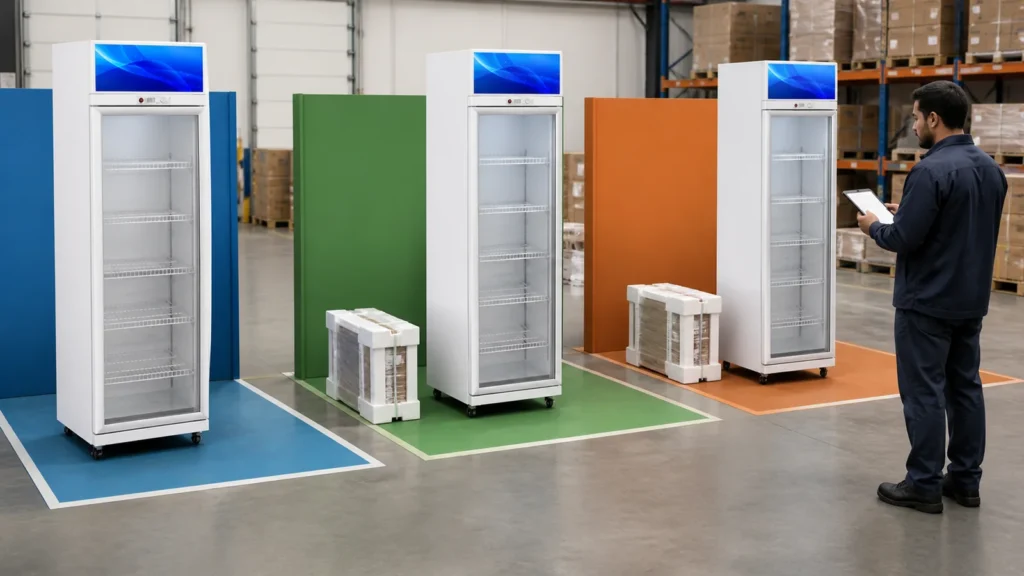
A multi-store beverage-cooler order is not complete when the total cabinet quantity matches. One dealer may need a different confirmed model, door count, shelf arrangement, artwork, body color, electrical selection, document language, or delivery date. If these choices live in separate spreadsheets, cabinets and accessory packs can exchange destinations during staging. A cabinet-level allocation matrix gives each upright glass-door cooler one destination and keeps every approved option with it from order release through dealer receipt.
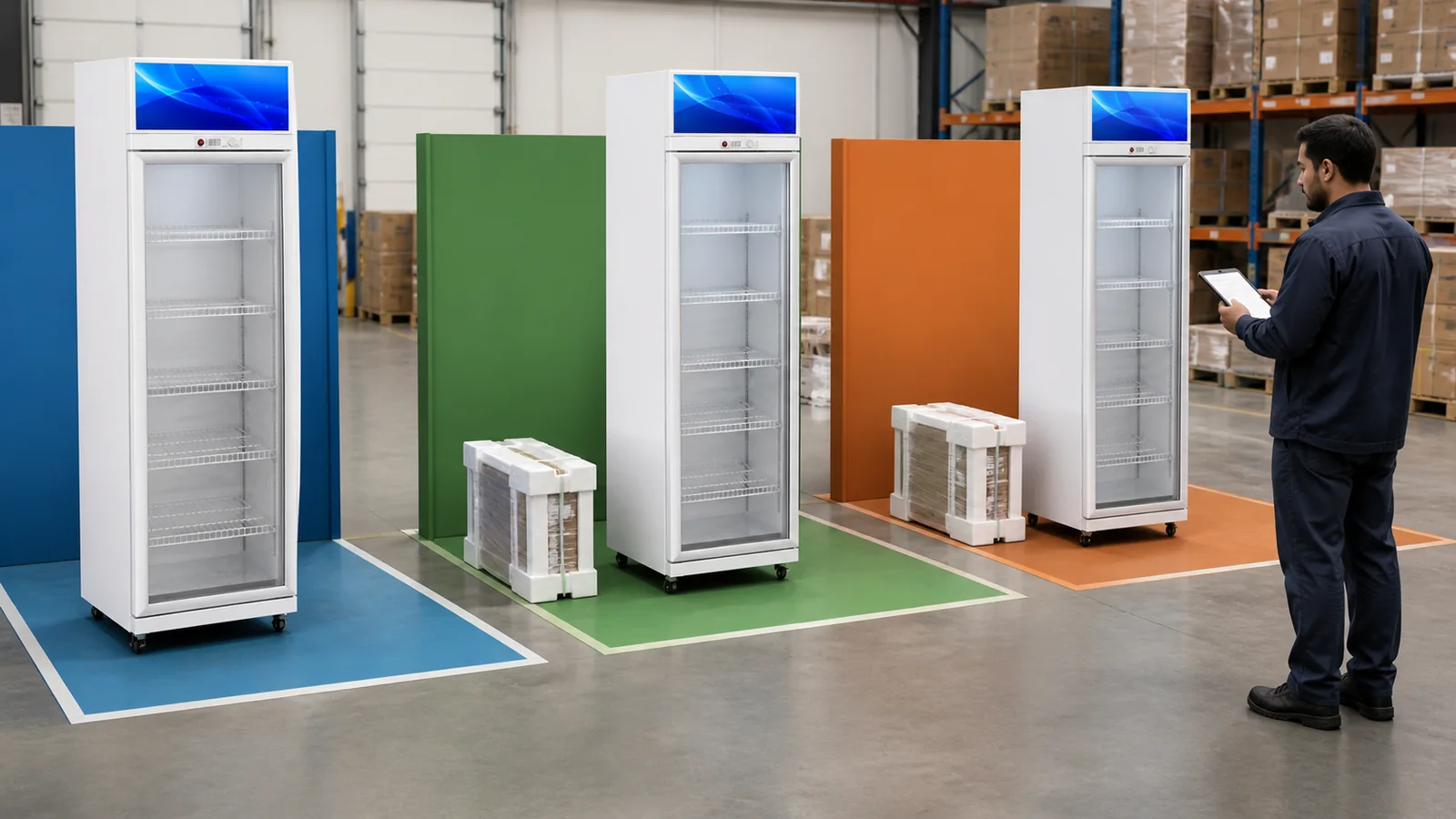
Create One Store and Cabinet Coding System
the project has stable destination codes for dealer, city or route as needed, store, order line, cabinet, and package without relying on similar store names. For this beverage cooler multi store delivery allocation task, the responsible team should issue controlled codes and map them to commercial records while limiting unnecessary personal or location data. The check belongs at the point where the physical condition and its identity can still be verified together.
At the create one store and cabinet coding system stage, retain dealer and store codes, order, route, cabinet sequence, package ID, and revision owner. Link each photograph, count, mark, drawing, or note to the beverage cooler multi store delivery allocation item it describes, including the current location and responsible role where those facts matter.
A filename, color sticker, or salesperson nickname cannot be the only destination identity. That boundary governs beverage cooler multi store delivery allocation, not a different product or site. When evidence supports more than one interpretation, record the uncertainty and route it to the qualified decision owner.
Close create one store and cabinet coding system only when all teams use the same code set. If open, preserve the beverage cooler multi store delivery allocation state and name the unresolved point, owner, next evidence, and hold or follow-up action before physical custody or project work changes.
Before moving on, compare dealer and store codes, order, route, cabinet sequence, package ID, and revision owner with the release condition: all teams use the same code set. This final comparison gives the beverage cooler multi store delivery allocation handoff enough context for the next buyer, supplier, warehouse, installer, operator, or project reviewer to act without rebuilding the chronology.
Freeze the Store-Level Product Schedule
each destination lists the confirmed beverage-cooler model, door count, shelf arrangement, color, artwork, electrical selection, and other documented options. For this beverage cooler multi store delivery allocation task, the responsible team should compare the schedule with quotations, dealer approvals, current model availability, and production acknowledgments. The check belongs at the point where the physical condition and its identity can still be verified together.
At the freeze the store-level product schedule stage, retain store code, model, quantity, options, proof revisions, open item, approval, and change cutoff. Link each photograph, count, mark, drawing, or note to the beverage cooler multi store delivery allocation item it describes, including the current location and responsible role where those facts matter.
Range availability does not mean every option is available on every model combination. That boundary governs beverage cooler multi store delivery allocation, not a different product or site. When evidence supports more than one interpretation, record the uncertainty and route it to the qualified decision owner.
Close freeze the store-level product schedule only when the allocation baseline is complete or clearly conditional. If open, preserve the beverage cooler multi store delivery allocation state and name the unresolved point, owner, next evidence, and hold or follow-up action before physical custody or project work changes.
Before moving on, compare store code, model, quantity, options, proof revisions, open item, approval, and change cutoff with the release condition: the allocation baseline is complete or clearly conditional. This final comparison gives the beverage cooler multi store delivery allocation handoff enough context for the next buyer, supplier, warehouse, installer, operator, or project reviewer to act without rebuilding the chronology.
Assign Physical Cabinets and Parts
actual cabinet and package IDs are mapped to stores after production and before staging or loading. For this beverage cooler multi store delivery allocation task, the responsible team should scan or record each unit and tie its shelves, supports, keys, documents, artwork pieces, and accessory packages to the same destination. The check belongs at the point where the physical condition and its identity can still be verified together.
At the assign physical cabinets and parts stage, retain unit ID, package label, store code, parts list, document pack, artwork, checker, and staging bay. Link each photograph, count, mark, drawing, or note to the beverage cooler multi store delivery allocation item it describes, including the current location and responsible role where those facts matter.
A correct model with the wrong store-specific artwork or shelf pack is still a misallocation. That boundary governs beverage cooler multi store delivery allocation, not a different product or site. When evidence supports more than one interpretation, record the uncertainty and route it to the qualified decision owner.
Close assign physical cabinets and parts only when each physical group reconciles to one destination. If open, preserve the beverage cooler multi store delivery allocation state and name the unresolved point, owner, next evidence, and hold or follow-up action before physical custody or project work changes.
Before moving on, compare unit ID, package label, store code, parts list, document pack, artwork, checker, and staging bay with the release condition: each physical group reconciles to one destination. This final comparison gives the beverage cooler multi store delivery allocation handoff enough context for the next buyer, supplier, warehouse, installer, operator, or project reviewer to act without rebuilding the chronology.
Multi-Store Allocation Matrix
The matrix reconciles commercial configuration, physical cabinet, loose parts, warehouse position, route, and dealer receipt.
| Review Point | Evidence | Hold or Release Question |
|---|---|---|
| Store requirement | Model, doors, shelves, options and proofs | Is the configuration approved? |
| Physical allocation | Cabinet, package, parts and documents | Does one group belong to one store? |
| Warehouse and route | Staging bay, moves and load check | Are destinations still separated? |
| Dealer receipt | Store-level identity, condition and exception | Did every destination close independently? |
Stage Without Mixing Dealer Destinations
warehouse bays, pallet groups, or route lanes keep cabinets and small packages distinguishable during allocation changes and loading. For this beverage cooler multi store delivery allocation task, the responsible team should use visible codes, controlled move transactions, physical separation, and a second check before combining route loads. The check belongs at the point where the physical condition and its identity can still be verified together.
At the stage without mixing dealer destinations stage, retain source and destination bay, mover, time, seal or package condition, route, short or over item, and checker. Link each photograph, count, mark, drawing, or note to the beverage cooler multi store delivery allocation item it describes, including the current location and responsible role where those facts matter.
Shared transport does not justify shared identity. That boundary governs beverage cooler multi store delivery allocation, not a different product or site. When evidence supports more than one interpretation, record the uncertainty and route it to the qualified decision owner.
Close stage without mixing dealer destinations only when the staged route total and store subtotals both match. If open, preserve the beverage cooler multi store delivery allocation state and name the unresolved point, owner, next evidence, and hold or follow-up action before physical custody or project work changes.
Before moving on, compare source and destination bay, mover, time, seal or package condition, route, short or over item, and checker with the release condition: the staged route total and store subtotals both match. This final comparison gives the beverage cooler multi store delivery allocation handoff enough context for the next buyer, supplier, warehouse, installer, operator, or project reviewer to act without rebuilding the chronology.
Control Late Allocation Changes
a store closure, dealer request, artwork delay, route change, or stock shortage does not cause an informal label swap. For this beverage cooler multi store delivery allocation task, the responsible team should open a revision that checks cabinet compatibility, options, documents, labels, commercial approval, staging move, and affected destination. The check belongs at the point where the physical condition and its identity can still be verified together.
At the control late allocation changes stage, retain old and new allocation, reason, approved differences, unit movement, label replacement, notified teams, and superseded record. Link each photograph, count, mark, drawing, or note to the beverage cooler multi store delivery allocation item it describes, including the current location and responsible role where those facts matter.
Destination reassignment cannot make an incompatible cabinet configuration acceptable. That boundary governs beverage cooler multi store delivery allocation, not a different product or site. When evidence supports more than one interpretation, record the uncertainty and route it to the qualified decision owner.
Close control late allocation changes only when every affected unit and store points to the revised schedule. If open, preserve the beverage cooler multi store delivery allocation state and name the unresolved point, owner, next evidence, and hold or follow-up action before physical custody or project work changes.
Before moving on, compare old and new allocation, reason, approved differences, unit movement, label replacement, notified teams, and superseded record with the release condition: every affected unit and store points to the revised schedule. This final comparison gives the beverage cooler multi store delivery allocation handoff enough context for the next buyer, supplier, warehouse, installer, operator, or project reviewer to act without rebuilding the chronology.
Verify Delivery Store by Store
drivers and dealer receivers can check cabinet, package, parts, documents, and visible condition against the store allocation before custody closes. For this beverage cooler multi store delivery allocation task, the responsible team should provide a destination-specific list and record shortages, overages, damage, wrong identity, or refused items without redistributing them casually. The check belongs at the point where the physical condition and its identity can still be verified together.
At the verify delivery store by store stage, retain store code, unit and package IDs, parts, condition views, receiver, exception, returned item, and closure owner. Link each photograph, count, mark, drawing, or note to the beverage cooler multi store delivery allocation item it describes, including the current location and responsible role where those facts matter.
Route-level delivery completion cannot hide one store-level mismatch. That boundary governs beverage cooler multi store delivery allocation, not a different product or site. When evidence supports more than one interpretation, record the uncertainty and route it to the qualified decision owner.
Close verify delivery store by store only when each destination has an independent signed outcome. If open, preserve the beverage cooler multi store delivery allocation state and name the unresolved point, owner, next evidence, and hold or follow-up action before physical custody or project work changes.
Before moving on, compare store code, unit and package IDs, parts, condition views, receiver, exception, returned item, and closure owner with the release condition: each destination has an independent signed outcome. This final comparison gives the beverage cooler multi store delivery allocation handoff enough context for the next buyer, supplier, warehouse, installer, operator, or project reviewer to act without rebuilding the chronology.
Buyer Checklist
- Use stable dealer, store, cabinet, and package codes.
- Freeze configuration by destination before allocation.
- Assign actual units and loose parts to stores.
- Separate destinations physically and in the system.
- Use controlled revisions for allocation changes.
- Check both route totals and store subtotals.
- Close receipt and exceptions for every store.
Frequently Asked Questions
Can identical cooler models be swapped between stores?
Only after confirming all approved options, artwork, color, electrical selection, shelves, documents, commercial allocation, unit identity, and delivery records remain correct.
Should one packing list cover the whole route?
A route summary is useful, but every store also needs a destination-specific list that can be checked at custody handoff.
What if one store refuses its cabinet?
Keep the unit identified, record reason and condition, preserve custody, update route and warehouse status, and obtain approval before any reassignment.
Related Product or Reading
Use the beverage-cooler RFQ detail guide to collect exact model, door, shelf, electrical, artwork, and packing choices before building the allocation matrix.
Discuss the Exact Project
Send ICEAGE the dealer and store schedule, beverage-cooler models, door counts, shelf plans, electrical choices, color and artwork proofs, documents, quantities, routes, staging plan, and change process.